Cost Management Explained: Practical Guide for Projects
Learn cost management with practical examples, steps, benefits, and mistakes to avoid. A simple guide for engineers, students, and project managers.
 Suraj Manikpuri
Cost Management: The Skill That Decides Whether a Project Makes Profit or Loss
Imagine this situation.
A company starts a project with a budget of ₹10 crore.
Everything looks perfect on paper. The design is ready, the team is excited, and the deadline is fixed.
But after a few months…
Costs start increasing.
Materials become expensive.
Extra work appears.
Poor planning leads to delays.
By the end of the project, the total cost becomes ₹14 crore.
Now the big question: Who will pay the extra ₹4 crore?
This is exactly where Cost Management becomes the hero.
Cost management ensures that projects stay within budget, profitable, and financially healthy. Whether it’s a construction project, software development, or a steel plant installation, cost control is the backbone of successful project execution.
Let’s understand this concept in a simple and practical way.
What is Cost Management?
Cost Management is the process of planning, estimating, budgeting, monitoring, and controlling project costs so that the project is completed within the approved budget.
In simple words:
Cost Management = Planning money + Tracking spending + Controlling expenses
Or in Hinglish:
"Kitna paisa lagega, kaha kharch hoga, aur budget ke andar kaise rakhenge — yehi Cost Management hai."
Cost management is one of the most critical parts of Project Management, along with scope, time, and quality.
Why Cost Management is So Important
Projects rarely fail because of lack of effort.
Most projects fail because of poor cost control.
Here’s why cost management matters:
1. Keeps the Project Profitable
Companies run projects to earn profit. If costs exceed estimates, profit disappears.
2. Helps in Better Decision Making
Managers can quickly decide whether to continue, modify, or stop a project.
3. Prevents Budget Overruns
Without cost monitoring, expenses quietly grow until it becomes too late.
4. Builds Client Trust
Clients trust companies that deliver projects on time and within budget.
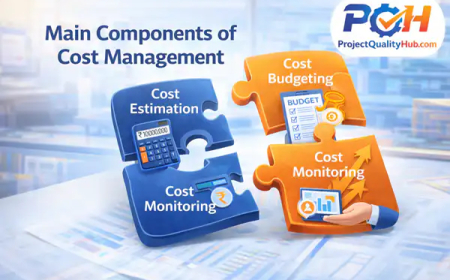
The 4 Major Steps of Cost Management
Cost management is not just one activity. It is a structured process.
1. Cost Estimation
This is the first step where we calculate how much the project will cost.
Common estimation methods include:
-
Expert judgment
-
Historical data
-
Parametric estimation
-
Bottom-up estimation
Example:
If you are installing a pipeline system, you estimate cost for:
-
Pipes
-
Valves
-
Pumps
-
Labor
-
Equipment
2. Cost Budgeting
After estimating costs, the next step is allocating money to different activities.
Example budget structure:
| Activity | Estimated Cost |
|---|---|
| Civil Work | ₹2 Cr |
| Mechanical Installation | ₹3 Cr |
| Electrical | ₹1 Cr |
| Equipment | ₹4 Cr |
Total Project Budget = ₹10 Cr
This becomes the baseline budget.
3. Cost Monitoring
Once the project starts, the actual spending must be tracked regularly.
Project managers compare:
Planned Cost vs Actual Cost
Tools used:
-
Earned Value Management (EVM)
-
Cost Performance Index (CPI)
-
Project dashboards
-
Primavera / MS Project
4. Cost Control
If spending starts increasing, corrective actions are taken.
Example actions:
-
Optimize manpower
-
Reduce material wastage
-
Re-plan schedules
-
Negotiate supplier prices
The goal is simple:
Bring the project back within budget.
Real Project Example: Steel Plant Installation
Let’s take a practical engineering example.
Suppose a company is installing a high-pressure water pump system in a steel plant.
Estimated cost:
| Item | Cost |
|---|---|
| Pump | ₹1.2 Cr |
| Motor | ₹80 Lakh |
| Civil foundation | ₹40 Lakh |
| Installation | ₹25 Lakh |
Total budget = ₹2.65 Cr
During execution:
-
Foundation cost increases due to soil issues
-
Extra piping required
-
Delay increases labor cost
Without cost management, the project could easily reach ₹3.5 Cr.
But with proper monitoring and planning, the project team can control the overrun and maintain profitability.
Step-by-Step Guide to Implement Cost Management
If you are a student, engineer, or project manager, follow this simple process.
Step 1: Define Project Scope
Clear scope prevents unnecessary expenses.
Step 2: Prepare Detailed Cost Estimate
Break the project into smaller tasks and estimate each.
Step 3: Create a Budget Baseline
Approve a fixed budget before execution begins.
Step 4: Track Costs Weekly
Use software or spreadsheets to monitor spending.
Step 5: Identify Cost Variance
Find where spending is higher than expected.
Step 6: Take Corrective Action
Reduce waste, renegotiate contracts, or adjust planning.
Advantages of Cost Management
✔ Better financial control
✔ Improved project profitability
✔ Higher client satisfaction
✔ Reduced financial risk
✔ Stronger decision-making
Companies with strong cost management systems are far more successful in large projects.
Disadvantages of Cost Management
While useful, it also has some challenges.
❌ Requires accurate data
❌ Time-consuming planning process
❌ Poor estimation can mislead planning
❌ Needs experienced project managers
But despite these challenges, the benefits are far greater than the drawbacks.
Common Cost Management Mistakes
Many projects fail due to simple mistakes.
1. Poor Cost Estimation
Wrong estimates lead to wrong budgets.
2. Ignoring Risk Factors
Unexpected events like inflation or delays increase cost.
3. Lack of Cost Tracking
Many teams estimate cost but never monitor it regularly.
4. Scope Creep
Clients keep adding new work without adjusting the budget.
Expert Tips from Real Project Experience
Here are some practical lessons experienced project engineers follow.
Tip 1: Always Add Contingency
Add 5–10% contingency in the budget.
Tip 2: Track Small Expenses
Small costs accumulate into big overruns.
Tip 3: Monitor Material Consumption
Material wastage directly increases cost.
Tip 4: Communicate With Suppliers
Price negotiation can save huge money.
Tip 5: Use Project Software
Tools like Primavera P6 or MS Project make cost tracking easier.
Cost Management vs Cost Control
Many people confuse these two terms.
| Cost Management | Cost Control |
|---|---|
| Overall financial planning | Monitoring actual spending |
| Happens before and during project | Happens during execution |
| Strategic approach | Operational approach |
Think of it like this:
Cost Management = Planning money
Cost Control = Protecting money
Conclusion
Cost management is not just about saving money.
It is about planning wisely, spending smartly, and delivering successful projects.
Whether you are managing a construction project, industrial installation, or software development, cost management ensures that:
-
Projects stay within budget
-
Companies remain profitable
-
Clients remain satisfied
In simple words:
A project without cost management is like a car without brakes — it may run fast, but it can crash anytime.
If you want to become a successful engineer, manager, or entrepreneur, mastering cost management is a skill you cannot ignore.
Frequently Asked Questions (FAQs)
1. What is cost management in project management?
Cost management is the process of planning, estimating, budgeting, and controlling project expenses to complete a project within the approved budget.
2. What are the main components of cost management?
The four main components are cost estimation, cost budgeting, cost monitoring, and cost control.
3. What tools are used for cost management?
Common tools include Primavera P6, MS Project, Excel dashboards, and Earned Value Management (EVM).
4. What causes cost overruns in projects?
Major reasons include poor planning, scope changes, inaccurate estimates, delays, and material price increases.
5. Why is cost management important in construction projects?
Construction projects involve large investments. Cost management helps prevent budget overruns and ensures profitability.