Main Components of Cost Management Explained
Learn the main components of cost management with simple examples, real project insights, and expert tips for engineers, students, and managers.
 Suraj Manikpuri
Main Components of Cost Management: The 4 Pillars That Control Project Costs
A few years ago, I saw an interesting situation during a project meeting.
The project looked perfectly planned. The drawings were approved, equipment was ordered, and the schedule was ready. But one senior manager asked a simple question:
“Do we know exactly how much this project will cost from start to finish?”
The room suddenly became quiet.
Everyone had partial numbers. Someone knew the equipment cost. Another knew the civil cost. But no one had a complete financial picture.
That moment clearly showed why understanding the main components of cost management is so important.
Without proper cost management, even technically perfect projects can become financial disasters.
In this article, we’ll break down the four main components of cost management in the simplest way possible, with practical examples that engineers, students, and project professionals can easily understand.
What is Cost Management in Simple Words?
Before we jump into the components, let’s understand the basic idea.
Cost management is the process of planning, estimating, budgeting, monitoring, and controlling project costs so that the project stays within the approved budget.
In Hinglish:
“Project me kitna paisa lagega, kaha kharch hoga, aur budget ke andar kaise complete karna hai — yehi cost management hai.”
Every successful project relies on four key building blocks.
The 4 Main Components of Cost Management
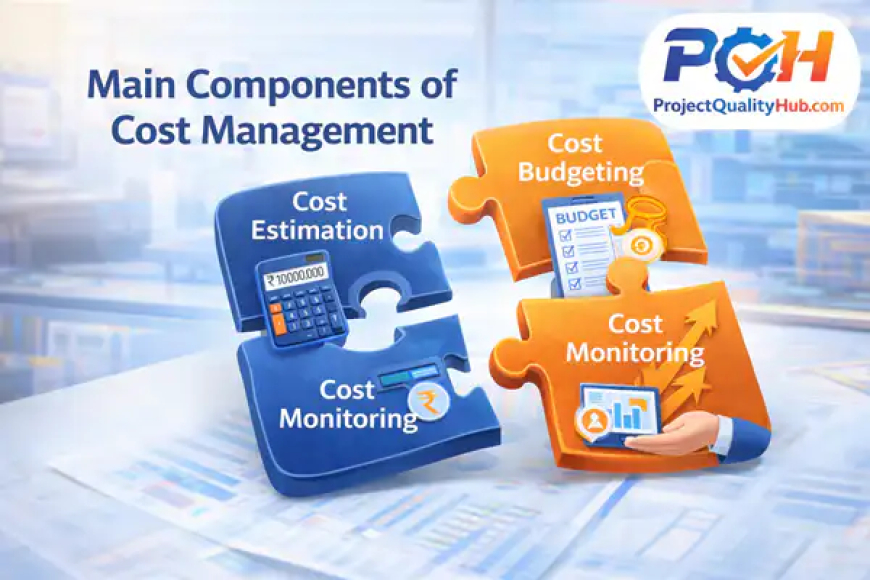
The main components of cost management are:
-
Cost Estimation
-
Cost Budgeting
-
Cost Monitoring
-
Cost Control
Think of these as four pillars supporting the financial stability of a project.
Let’s explore each one.
1. Cost Estimation – Predicting the Project Cost
Cost estimation is the process of predicting how much money will be required to complete a project.
This happens before the project begins.
Engineers and project planners calculate costs for:
-
Materials
-
Labor
-
Equipment
-
Transportation
-
Installation
-
Contingency
Example
Suppose you are installing a pipeline system in a steel plant.
Estimated cost breakdown:
| Item | Estimated Cost |
|---|---|
| Pipes | ₹40 Lakh |
| Valves | ₹15 Lakh |
| Pumps | ₹60 Lakh |
| Installation | ₹20 Lakh |
Total Estimated Cost = ₹1.35 Crore
This estimate becomes the foundation for project budgeting.
2. Cost Budgeting – Allocating the Money
Once the estimated cost is ready, the next component is cost budgeting.
Budgeting means allocating the total project cost to different project activities.
This creates a cost baseline.
Example Budget Structure
| Project Activity | Budget |
|---|---|
| Civil Work | ₹2 Cr |
| Mechanical Installation | ₹3 Cr |
| Electrical Work | ₹1 Cr |
| Equipment Purchase | ₹4 Cr |
Total Budget = ₹10 Crore
This budget acts as the financial roadmap for the entire project.
3. Cost Monitoring – Tracking Actual Spending
Once the project starts, spending must be tracked regularly.
This process is called cost monitoring.
The project team compares:
Planned Cost vs Actual Cost
If the difference becomes large, it indicates a potential cost overrun.
Tools Used for Monitoring
-
Excel dashboards
-
Primavera P6
-
MS Project
-
Earned Value Management (EVM)
Regular monitoring helps detect financial problems before they become serious.
4. Cost Control – Keeping the Project Within Budget
Cost control is the action taken when spending exceeds the planned budget.
If the project starts overspending, managers must take corrective steps such as:
-
Reducing unnecessary expenses
-
Negotiating supplier prices
-
Optimizing manpower
-
Improving material usage
In simple terms:
Cost control protects the project from financial damage.