Introduction
A few years back, one of my colleagues at a steel plant asked me a simple question:
"Sir, experience toh mil raha hai, but growth fast kaise karein?"
The honest answer was — skills + certification.
If you are a Quality Engineer, QA/QC Inspector, or even a fresher, you already know that experience alone is not enough. Companies today want certified professionals who understand systems, standards, and real field problems.
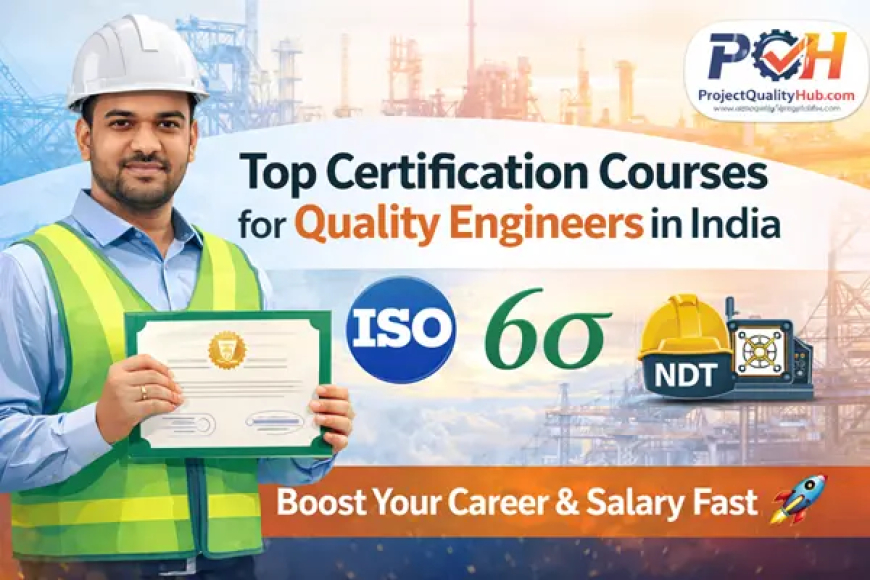
That’s why understanding the list of certification courses and their benefits for Quality Engineers can completely change your career path.
Let’s break it down in a simple and practical way 👇
What are Certification Courses for Quality Engineers?
Certification courses are professional training programs that validate your skills in quality control, quality assurance, testing, inspection, and process improvement.
Simple Meaning:
Ye aise courses hote hain jo aapko ek verified expert banate hain — matlab aap sirf kaam nahi karte, aapko proper standard ke according kaam karna aata hai.
Example:
If you are working in a fabrication shop and you have NDT Level II certification, your value automatically increases because you are officially qualified to inspect weld quality.
List of Certification Courses for Quality Engineers
Below is a practical list based on real industry demand, especially in sectors like steel plants, manufacturing, EPC, and oil & gas.
Focus: Process improvement and defect reduction
Best For: Production + Quality Engineers
Benefits:
-
Improves problem-solving skills
-
Helps in root cause analysis
-
Increases promotion chances
-
Useful in all industries
Real Example:
In rolling mill operations, Six Sigma tools help reduce rejection rate and improve productivity.
2. ISO 9001 Lead Auditor Certification
Focus: Quality Management System (QMS)
Best For: QA Managers, Documentation Engineers
Benefits:
-
You can conduct internal and external audits
-
High demand in manufacturing and service sectors
-
Required for ISO-certified companies
Simple Meaning:
Company ka pura quality system ka audit karna — documentation se lekar implementation tak.
3. NDT (Non-Destructive Testing) Level I, II, III
Methods include:
Best For: Welding, fabrication, pressure vessels
Benefits:
-
High demand in steel plants, oil & gas, power plants
-
High salary potential
-
International job opportunities
Real-life Example:
Pressure vessel inspection at Bhilai Steel Plant requires certified NDT engineers.
4. Welding Inspector Certification (CSWIP / AWS)
Focus: Welding quality and inspection
Benefits:
-
International recognition
-
High demand in EPC projects
-
Required for structural fabrication
5. Lean Manufacturing Certification
Focus: Waste reduction and efficiency improvement
Benefits:
-
Improves production flow
-
Reduces cost
-
Improves productivity
Hinglish:
Kam waste, zyada output — simple!
6. Total Quality Management (TQM)
Focus: Company-wide quality improvement
Benefits:
-
Strong management understanding
-
Useful for leadership roles
-
Improves customer satisfaction
7. Quality Control (QC) Tools Certification
Includes:
Benefits:
-
Strong analytical skills
-
Better decision making
-
Reduces defects
8. Calibration & Metrology Certification
Focus: Measurement and instrument accuracy
Benefits:
9. Oil & Gas QA/QC Certification
Focus: Pipeline, refinery, and EPC project quality
Benefits:
Practical Case Study (Real Use)
At a heavy fabrication unit, rejection rate was 8%. After implementing:
The rejection reduced to 2.1% within 6 months.
That is the real power of certified quality engineers.
Step-by-Step Guide: How to Choose the Right Certification
Step 1: Identify Your Industry
-
Steel plant
-
Oil & Gas
-
Automobile
-
EPC
Step 2: Check Your Role
-
QA/QC
-
Production
-
Inspection
-
Design
Step 3: Select Certification Based on Goal
Step 4: Choose Recognized Institute
Always select:
-
ASNT
-
IRCA
-
MSME approved
-
ISO certified institutes
Advantages of Certification Courses
✔ Better job opportunities
✔ Higher salary
✔ Strong technical knowledge
✔ Promotion chances increase
✔ Global job scope
Disadvantages
❌ Some courses are expensive
❌ Time required for preparation
❌ Fake institutes available (be careful)
Common Mistakes to Avoid
❌ Doing too many certifications without experience
❌ Choosing non-recognized institutes
❌ Not applying knowledge practically
❌ Following trend without career planning
Expert Tips (From Real Industry Experience)
✔ Always combine experience + certification
✔ Start with QC tools + ISO if you are fresher
✔ For site jobs, go for NDT or Welding inspector
✔ For management role, go for Six Sigma Black Belt
✔ Keep updating your certification every few years
If you truly want to grow in your career, understanding the list of certification courses and their benefits for Quality Engineers is a game changer.
Experience will give you confidence, but certification will give you recognition.
So start small, choose wisely, and upgrade your skills step by step.
Yaad rakhiye — skill + certificate = strong career growth 🚀
FAQs
1. Which certification is best for a fresher quality engineer?
Start with QC tools + ISO 9001 internal auditor certification.
2. Which certification gives highest salary?
NDT Level II/III and Welding Inspector (CSWIP/AWS) have highest earning potential.
3. Is Six Sigma useful for quality engineers?
Yes, it helps in problem solving and process improvement.
4. Can I do QA/QC certification online?
Yes, theory part online ho sakta hai, but practical training is important.
5. Which certification is best for Gulf jobs?
NDT + Welding Inspector + ISO Lead Auditor.

 Suraj Manikpuri