Top 15 Causes of Pump Failure and Solutions (2026): Complete Industrial Troubleshooting Guide
Pump failures can stop production and increase maintenance costs. Learn the top 15 causes of pump failure, warning signs, practical solutions, troubleshooting steps, and maintenance tips used in real industrial applications.
 Suraj Manikpuri
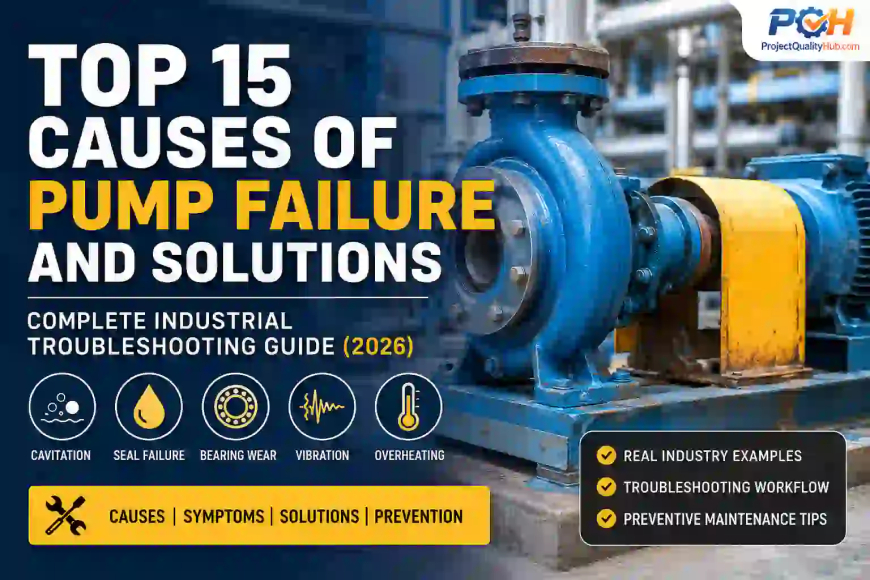
Top 15 Causes of Pump Failure and Solutions (2026): Complete Industrial Troubleshooting Guide
Why Pump Failures Can Become Expensive Very Quickly
Imagine a cooling water pump suddenly stopping during production. Operators start receiving alarms. Flow drops. Temperature begins increasing. Maintenance teams rush to identify the issue while production managers worry about downtime.
This situation is common in industries worldwide.
Whether it is a steel plant, chemical plant, water treatment facility, oil refinery, or manufacturing unit, pumps are among the hardest-working pieces of equipment. When they fail unexpectedly, the result is often:
- Production loss
- Higher maintenance cost
- Energy waste
- Emergency shutdowns
- Safety risks
The important thing is that pumps rarely fail without warning.
Most pumps start giving signals such as:
✔ Unusual vibration
✔ Leakage around seals
✔ Increased power consumption
✔ Strange noise
✔ Reduced flow rate
✔ Temperature rise
Understanding these warning signs early can prevent costly breakdowns.
In this guide, you will learn:
- Top 15 causes of pump failure
- Practical solutions
- Real industrial examples
- Troubleshooting workflow
- Common mistakes
- Preventive maintenance strategies
Early Warning Signs Your Pump May Fail Soon
Many maintenance teams wait until a pump completely stops working. That approach usually increases repair cost.
Watch for these warning signs:
| Warning Sign | Possible Cause |
|---|---|
| High vibration | Misalignment, cavitation |
| Noise increase | Bearing failure |
| Seal leakage | Seal damage |
| High temperature | Lubrication issue |
| Reduced discharge flow | Suction blockage |
| Motor current increase | Overload |
If two or more symptoms appear together, inspection should start immediately.
Top 15 Causes of Pump Failure and Their Solutions
1. Why Pump Cavitation Happens and How to Prevent It
Cavitation happens when liquid pressure drops below vapor pressure and vapor bubbles form inside the pump.
When these bubbles collapse, they create small shock waves that damage pump surfaces.
Symptoms
- Crackling sound
- Excessive vibration
- Reduced discharge pressure
- Impeller pitting
Industry example
In high-pressure descaling systems used in steel plants, insufficient suction pressure can create cavitation conditions.
Solution
- Increase available NPSH
- Reduce suction losses
- Increase suction pipe diameter
- Avoid excessive flow demand
Prevention Tip
Never ignore crackling or marble-like noise.
2. Dry Running
A pump should not operate without fluid.
Without liquid, cooling and lubrication disappear.
Symptoms
- High temperature
- Seal burning smell
- Rapid seal wear
Solution
- Install dry-run protection
- Use tank level sensors
- Monitor suction conditions
3. Mechanical Seal Failure
Mechanical seals prevent fluid leakage.
Seal problems are among the most common maintenance issues.
Common reasons
- Improper installation
- Contamination
- Dry operation
- Pressure fluctuations
Solution
- Inspect seal faces
- Verify alignment
- Check operating conditions
- Replace damaged components
4. Bearing Failure
Bearings support shaft rotation.
Poor bearing conditions can create multiple secondary problems.
Symptoms
- Noise increase
- Heat generation
- Vibration increase
Practical example
A cooling water pump starts vibrating after lubrication schedules are skipped.
Solution
- Follow lubrication schedules
- Monitor bearing temperature
- Replace damaged bearings
5. Shaft Misalignment
Misalignment creates uneven loading.
Symptoms
- Coupling wear
- High vibration
- Bearing failures
Solution
Use:
- Laser alignment systems
- Dial indicators
- Alignment checks after maintenance
6. Excessive Vibration
Vibration itself is usually not the root cause.
Possible causes include:
- Unbalanced impeller
- Loose foundation
- Bearing wear
- Cavitation
Solution
Conduct vibration analysis before replacing parts.
7. Incorrect Lubrication
Many failures occur because of lubrication mistakes.
Common mistakes
❌ Mixing grease types
❌ Over-greasing bearings
❌ Ignoring schedules
Solution
Always use manufacturer-recommended lubricant grades.
8. Operating Away from Best Efficiency Point (BEP)
Every pump has a Best Efficiency Point.
Running too far from BEP creates stress.
| Condition | Result |
|---|---|
| Near BEP | Maximum efficiency |
| Below BEP | Internal recirculation |
| Above BEP | Motor overload |
Solution
Select pumps according to actual process requirements.
9. Corrosion and Erosion Damage
Aggressive fluids gradually remove material.
Examples
Corrosive fluids:
- Acids
- Saltwater
- Chemicals
Abrasive fluids:
- Slurry
- Sand
- Scale particles
Solution
- Use suitable materials
- Install strainers
- Apply coatings
10. Suction Line Blockage
Restricted suction starves the pump.
Symptoms
- Reduced flow
- Noise increase
- Pressure drop
Solution
- Clean strainers
- Check valves
- Inspect pipelines
11. Motor Overload
Motor overload can originate from hydraulic problems.
Causes
- High fluid viscosity
- Oversized impeller
- Excessive flow
Solution
- Verify motor sizing
- Check current values
- Review process conditions
12. Incorrect Pump Selection
Selecting the wrong pump creates recurring failures.
Example
Using a high-capacity pump for a low-flow application.
Results
- Reduced efficiency
- Energy loss
- Frequent repairs
Solution
Verify:
- Flow requirement
- Head requirement
- Fluid characteristics
- Temperature
13. Weak Foundation and Loose Bolts
Poor installation affects reliability.
Symptoms
- Vibration
- Misalignment
- Noise
Solution
- Tighten anchor bolts
- Check grouting
- Verify base flatness
14. Extreme Temperature Conditions
High temperatures affect:
- Bearings
- Seals
- Lubricants
Solution
- Use temperature-resistant materials
- Add cooling systems
- Monitor temperatures continuously
15. Lack of Preventive Maintenance
Many failures are preventable.
Waiting for breakdowns increases costs.
Recommended maintenance schedule
| Inspection Activity | Frequency |
|---|---|
| Bearing inspection | Monthly |
| Seal inspection | Monthly |
| Vibration measurement | Monthly |
| Alignment check | Quarterly |
| Lubrication review | Monthly |
Pump Failure Troubleshooting Workflow
When a pump starts showing abnormal behavior:
Step 1: Observe symptoms
Check:
- Noise
- Leakage
- Temperature
- Vibration
Step 2: Collect operating data
Measure:
- Pressure
- Flow
- Current
- Temperature
Step 3: Identify possible causes
Compare symptoms with known failure patterns.
Step 4: Inspect components
Check:
- Bearings
- Seals
- Couplings
- Suction lines
Step 5: Correct and monitor
Perform repair and monitor performance.
Pro Tip
Do not immediately replace damaged components.
For example, if a bearing fails because of shaft misalignment, replacing only the bearing may cause the same issue to return.
Find the root cause before replacing parts.
Common Mistakes Engineers Make
❌ Ignoring small vibration increases
❌ Running pumps below minimum flow
❌ Over-greasing bearings
❌ Ignoring suction conditions
❌ Replacing parts without root cause analysis
❌ Skipping periodic alignment checks
Future Trends in Pump Reliability
Industrial maintenance is changing rapidly.
Emerging technologies include:
- AI-based predictive maintenance
- Wireless vibration sensors
- IoT monitoring systems
- Digital twins
- Cloud-based maintenance analytics
These technologies help reduce unplanned downtime and improve reliability.
Frequently Asked Questions
What is the most common cause of pump failure?
Mechanical seal damage and bearing failures are among the most common reasons.
How do I know if a pump is cavitating?
Typical signs include vibration, crackling noise, and reduced performance.
Can dry running damage a pump?
Yes. Dry running can quickly damage seals and bearings.
Why does a pump suddenly lose flow?
Possible causes include blocked suction lines, cavitation, or worn components.
How often should industrial pumps be inspected?
Critical pumps are commonly inspected monthly, while important systems may use continuous monitoring.
Key Takeaways
✔ Pump failures usually provide warning signs early
✔ Cavitation and bearing damage are major causes
✔ Operating near Best Efficiency Point improves reliability
✔ Preventive maintenance reduces downtime
✔ Root cause analysis prevents repeat failures
✔ Predictive monitoring is becoming standard practice