Why Motors Overheat: Complete Troubleshooting Guide (2026) – Causes, Solutions & Prevention
Learn why motors overheat and how to troubleshoot them effectively. Discover common causes, warning signs, practical solutions, maintenance tips, and prevention methods for industrial electric motors.
 Suraj Manikpuri
Why Motors Overheat: Complete Troubleshooting Guide (2026)
Why Motor Overheating Can Become a Serious Problem
Imagine a production line suddenly stopping because the motor driving a pump, conveyor, blower, or compressor trips unexpectedly.
Maintenance personnel reach the motor and notice:
- Burning smell
- High body temperature
- Overload relay tripped
- Reduced machine performance
This scenario is common in industries worldwide.
Motors are the backbone of industrial operations. Whether in steel plants, manufacturing units, cement plants, water treatment systems, or processing industries, motors run continuously for long hours. Excessive heating can reduce efficiency, damage insulation, shorten motor life, and eventually cause complete failure.
The good news is that motors rarely overheat suddenly without showing early warning signs.
In this guide you will learn:
✔ Common causes of motor overheating
✔ Troubleshooting workflow
✔ Real industrial examples
✔ Solutions and preventive actions
✔ Maintenance checklist
Early Warning Signs of Motor Overheating
Before failure occurs, motors usually show symptoms.
| Warning Sign | Possible Cause |
|---|---|
| Burning smell | Insulation damage |
| High motor body temperature | Overload |
| Frequent tripping | Current increase |
| Abnormal noise | Bearing issue |
| Reduced speed | Voltage problem |
| High current | Mechanical loading |
If multiple symptoms occur together, immediate inspection should start.
Top Causes of Motor Overheating and Solutions
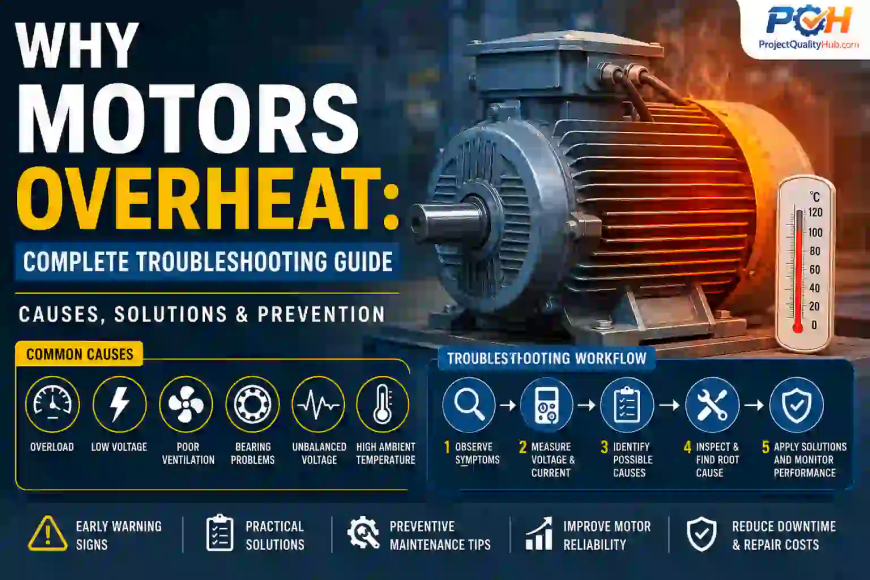
1. Motor Overload
Motor overload is among the most common reasons for overheating.
The motor draws more current than its rated capacity.
Symptoms
- High current
- Frequent overload relay trip
- Temperature rise
Industry example
A conveyor motor designed for normal material handling starts carrying excess load because of material buildup.
Solutions
- Reduce load
- Verify motor rating
- Measure current
Prevention Tip
Operate motors within rated capacity.
2. Low Voltage Supply
Low voltage forces the motor to draw additional current.
Higher current means more heat generation.
Symptoms
- Slow motor speed
- High current
- Temperature increase
Solutions
- Check incoming voltage
- Inspect cable sizing
- Verify power supply condition
3. Unbalanced Voltage
Even a small voltage imbalance can create serious heating problems.
Symptoms
- Uneven phase current
- Vibration
- Reduced efficiency
Practical example
Three-phase motors in large plants sometimes receive unequal voltage because of distribution problems.
Solution
Maintain voltage imbalance below recommended limits.
4. Bearing Problems
Bearings support shaft rotation.
Damaged bearings increase friction.
Symptoms
- Noise
- Vibration
- Temperature rise
Solution
- Check bearing condition
- Lubricate properly
- Replace damaged bearings
5. Poor Ventilation
Motor cooling depends on airflow.
Blocked ventilation reduces heat removal.
Symptoms
- Dust accumulation
- High surface temperature
Solutions
- Clean cooling fins
- Remove dirt
- Maintain air circulation
6. High Ambient Temperature
Motor performance reduces at high environmental temperatures.
Industry scenario
Motors operating near furnaces, reheating units, or high-temperature industrial areas frequently experience thermal stress.
Solutions
- Improve ventilation
- Install cooling fans
- Use suitable motor insulation class
7. Improper Lubrication
Too little or too much lubrication creates heat.
Common mistakes
❌ Over-greasing bearings
❌ Mixing lubricants
❌ Ignoring lubrication schedule
Solutions
Use manufacturer-recommended grease quantities.
8. Single Phasing
Single phasing occurs when one phase becomes disconnected.
The motor may continue running but with severe heating.
Symptoms
- Humming sound
- Low torque
- Current imbalance
Solutions
- Check fuse condition
- Inspect contactors
- Verify phase supply
9. Frequent Starting and Stopping
Motor starting current is much higher than running current.
Repeated starting creates excessive heat.
Solution
- Limit start frequency
- Use soft starters
- Use VFD systems
10. Rotor Problems
Rotor defects affect magnetic performance.
Symptoms
- Vibration
- Current fluctuation
- Temperature rise
Solutions
- Conduct motor testing
- Inspect rotor condition
11. Wrong Motor Selection
Using undersized motors creates constant overload.
Example
A small motor installed for a heavy-duty pump application.
Result
- Overheating
- Reduced life
- Frequent trips
Solution
Verify:
- Power requirement
- Duty cycle
- Starting torque
12. Mechanical Misalignment
Misalignment creates additional shaft load.
Symptoms
- Vibration
- Bearing wear
- Heat generation
Solutions
- Perform alignment checks
- Use laser alignment tools
13. Cooling Fan Failure
Many motors use fans for heat dissipation.
Symptoms
- High temperature
- Reduced airflow
Solutions
- Inspect fan blades
- Replace damaged fans
14. Harmonics and Power Quality Problems
Modern drives and electronic systems may create harmonics.
Effects
- Extra heat generation
- Efficiency reduction
Solutions
- Install filters
- Use proper VFD settings
15. Lack of Preventive Maintenance
Ignoring maintenance gradually creates multiple issues.
Recommended maintenance schedule
| Activity | Frequency |
|---|---|
| Current monitoring | Monthly |
| Bearing inspection | Monthly |
| Temperature check | Monthly |
| Alignment check | Quarterly |
| Cleaning | Monthly |
Motor Overheating Troubleshooting Workflow
When motor temperature becomes abnormal:
Step 1: Observe symptoms
Check:
- Temperature
- Noise
- Vibration
- Smell
Step 2: Collect operating data
Measure:
- Current
- Voltage
- Load
- Ambient temperature
Step 3: Identify probable causes
Compare symptoms with known failure patterns.
Step 4: Inspect components
Check:
- Bearings
- Cooling fan
- Electrical connections
- Ventilation
Step 5: Repair and monitor
Correct the issue and monitor performance.
Pro Tip
Do not immediately replace the motor.
In many cases, motors are replaced while the real issue exists elsewhere such as:
- Pump overload
- Misalignment
- Low voltage
- Mechanical binding
Always identify the root cause first.
Common Mistakes Engineers Make
❌ Ignoring small temperature increases
❌ Over-greasing bearings
❌ Skipping alignment checks
❌ Using incorrect motor ratings
❌ Ignoring ventilation problems
❌ Assuming motor failure without measurement
Future Trends in Motor Monitoring
Motor maintenance is becoming smarter.
Emerging technologies include:
- AI-based predictive maintenance
- Thermal imaging systems
- IoT temperature sensors
- Wireless vibration monitoring
- Cloud-based motor analytics
These technologies help reduce unplanned failures.
Frequently Asked Questions
Why does a motor suddenly become hot?
Common reasons include overload, low voltage, poor ventilation, and bearing problems.
What temperature is too high for a motor?
It depends on insulation class, but abnormal temperature rise above design limits requires investigation.
Can low voltage cause motor overheating?
Yes. Low voltage increases current demand and heat generation.
Why do bearings cause overheating?
Damaged bearings create friction and increase motor load.
How often should motors be inspected?
Critical motors are commonly inspected monthly, while important applications may use continuous monitoring.
Key Takeaways
✔ Motor overheating usually gives early warning signs
✔ Overload and poor ventilation are common causes
✔ Current and voltage measurements help identify problems
✔ Preventive maintenance reduces failures
✔ Root cause analysis prevents repeat breakdowns
✔ Predictive monitoring is becoming standard practice