15 Most Important Documents to Check Before Starting Construction
Learn the 15 most important documents to check before starting construction. Avoid delays, disputes, rework, and costly project mistakes.
 Suraj Manikpuri
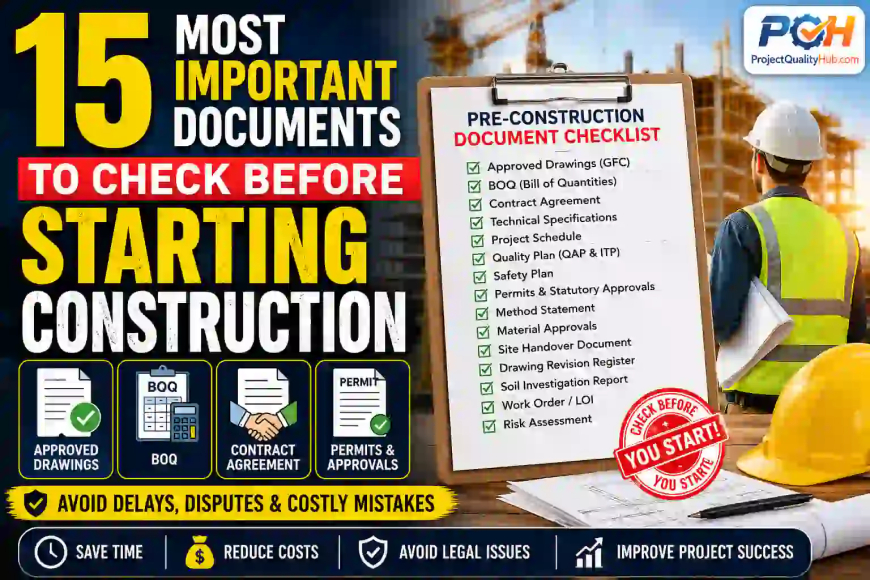
15 Most Important Documents to Check Before Starting Construction (2026 Practical Guide)
Before starting any construction project, the most important documents to verify are approved drawings, contract agreement, BOQ (Bill of Quantities), technical specifications, project schedule, work permits, quality plan, safety plan, and statutory approvals. Missing or outdated documents can lead to rework, delays, disputes, safety incidents, and major financial losses.
Introduction
Imagine mobilizing manpower, machinery, and materials to a construction site only to discover that the latest structural drawing was never approved.
This happens more often than many people think.
In real projects, especially in industrial plants, buildings, infrastructure projects, and EPC contracts, many delays occur not because of technical problems but because teams start work without reviewing critical documents.
I have personally seen projects lose lakhs of rupees due to incorrect drawings, missing approvals, and unclear contract clauses.
In this guide, you will learn exactly which documents must be checked before construction starts, why they matter, common mistakes to avoid, and a practical site checklist that can save significant time and money.
What Are Pre-Construction Documents?
Pre-construction documents are the approved records, drawings, specifications, permits, and contractual documents required before physical construction activities begin.
These documents provide:
-
Scope clarity
-
Technical requirements
-
Legal authorization
-
Quality requirements
-
Safety requirements
-
Commercial obligations
Without these documents, the project team may work based on assumptions rather than facts.
Why Checking Documents Before Construction Is Critical
Construction projects involve multiple stakeholders:
-
Client
-
Consultant
-
Contractor
-
Vendors
-
Authorities
-
End Users
Even a small discrepancy can create:
| Issue | Possible Impact |
|---|---|
| Wrong Drawing | Rework |
| Missing Approval | Work Stoppage |
| Contract Ambiguity | Claims & Disputes |
| Incorrect BOQ | Cost Overrun |
| Missing Permit | Legal Penalty |
| Safety Plan Missing | Accidents |
A single day of shutdown on a large industrial project can cost thousands of dollars.
15 Most Important Documents to Check Before Starting Construction
1. Contract Agreement
This is the foundation document of the project.
Verify:
-
Scope of work
-
Completion period
-
Payment terms
-
LD (Liquidated Damages)
-
Variation clauses
-
Extension of Time provisions
Practical Tip
Never rely only on the purchase order. Always review the complete contract agreement.
2. Approved Good for Construction (GFC) Drawings
These are the most important technical documents.
Examples:
-
Civil drawings
-
Structural drawings
-
Architectural drawings
-
Mechanical drawings
-
Electrical drawings
-
Piping drawings
Check:
-
Revision number
-
Approval status
-
Latest issue date
Common Mistake
Using old drawings downloaded months earlier.
3. Bill of Quantities (BOQ)
BOQ defines project quantities.
Verify:
-
Quantities
-
Units
-
Item descriptions
-
Excluded items
BOQ is essential for:
-
Procurement
-
Billing
-
Cost control
4. Technical Specifications
Specifications explain how work should be executed.
Examples:
-
Concrete grade
-
Welding standards
-
Painting requirements
-
Material standards
Many quality failures occur because teams only read drawings and ignore specifications.
5. Project Schedule
The project schedule establishes execution priorities.
Typically prepared using:
-
Primavera P6
-
Microsoft Project
Review:
-
Milestones
-
Critical activities
-
Resource requirements
-
Shutdown periods
6. Work Order or Letter of Intent (LOI)
Confirm:
-
Authorized scope
-
Contract value
-
Start date
-
Completion date
Starting work without a valid work order can create payment issues later.
7. Construction Method Statement
This document explains:
-
How work will be performed
-
Equipment to be used
-
Safety precautions
-
Inspection requirements
Examples:
-
Foundation casting
-
Structural erection
-
Pipeline installation
8. Quality Assurance Plan (QAP)
QAP defines:
-
Inspection points
-
Testing requirements
-
Acceptance criteria
-
Documentation requirements
A proper QAP reduces rejection and rework.
9. Inspection and Test Plan (ITP)
ITP specifies:
-
Hold points
-
Witness points
-
Inspection stages
Without an approved ITP, completed work may not be accepted by the client.
10. Safety Plan and Risk Assessment
Before construction begins, review:
-
Hazard identification
-
Emergency procedures
-
PPE requirements
-
Work permits
Safety must be planned before execution.
11. Statutory Approvals and Permits
Depending on project type:
-
Building permit
-
Fire NOC
-
Environmental clearance
-
Factory approval
-
Electrical permit
Missing approvals can stop the project immediately.
12. Soil Investigation Report
Particularly important for civil projects.
Provides:
-
Bearing capacity
-
Groundwater level
-
Soil characteristics
Incorrect assumptions can lead to foundation failures.
13. Material Approval Documents
Verify approved:
-
Cement
-
Steel
-
Structural materials
-
Equipment
-
Cables
-
Valves
Using unapproved materials may result in rejection.
14. Site Handover Document
Check:
-
Site boundaries
-
Access roads
-
Utilities availability
-
Existing structures
Many disputes arise because site conditions differ from assumptions.
15. Drawing Revision Register
One of the most overlooked documents.
This register tracks:
-
Latest revisions
-
Superseded drawings
-
Approved changes
Maintaining revision control prevents costly errors.
Practical Construction Document Review Workflow
Step 1
Review contract documents.
Step 2
Verify approved drawings.
Step 3
Check BOQ and specifications.
Step 4
Review schedule and milestones.
Step 5
Verify permits and approvals.
Step 6
Approve QAP and ITP.
Step 7
Review safety documents.
Step 8
Conduct pre-construction meeting.
Step 9
Issue site mobilization approval.
Step 10
Start construction activities.
Real Industry Case Study
Structural Steel Fabrication Delay
An industrial project started fabrication using Revision-1 drawings.
Two weeks later, Revision-3 drawings were issued.
Result:
-
35 tons of steel reworked
-
Project delayed by 18 days
-
Additional cost incurred
-
Client dissatisfaction
Root Cause:
No document control process existed.
Lesson:
Always verify the latest approved drawing before execution.
Comparison Table: Which Documents Are Most Critical?
| Document | Technical Impact | Commercial Impact | Legal Impact |
|---|---|---|---|
| Contract Agreement | Medium | High | High |
| GFC Drawings | High | Medium | Low |
| BOQ | Medium | High | Medium |
| Specifications | High | Medium | Low |
| Permits | Low | Medium | High |
| Safety Plan | Medium | Low | High |
| QAP & ITP | High | Medium | Medium |
Common Mistakes Before Starting Construction
Starting work with outdated drawings
Ignoring technical specifications
Missing permits
No approved QAP
Incomplete site handover
Poor document control
Lack of revision tracking
No risk assessment
These mistakes frequently cause delays and disputes.
Expert Tips from Construction Professionals
- Create a document checklist before mobilization.
- Maintain a document register.
- Use cloud-based document control.
- Verify every drawing revision.
- Conduct pre-construction review meetings.
- Train supervisors on document management.
- Never start critical activities without approvals.
Conclusion
If someone asks, "What is the most important document to check before starting construction?" the practical answer is: approved GFC drawings. However, successful projects rely on a complete document package that includes contracts, specifications, BOQ, permits, quality plans, safety plans, and revision controls.
The best construction professionals never start work based on assumptions. They start with documents, approvals, and proper planning. Spending a few hours reviewing documents before construction can save weeks of rework and significant project costs later.
Frequently Asked Questions (FAQs)
What is the most important document before construction starts?
Approved Good for Construction (GFC) drawings are generally considered the most critical document.
Why are construction drawings important?
They provide exact dimensions, layouts, and technical requirements for execution.
What is a BOQ in construction?
BOQ stands for Bill of Quantities and contains detailed quantities of project work items.
What permits are required before construction?
Building permits, environmental approvals, fire clearances, and local authority approvals may be required.
What happens if work starts without approval?
The project may face legal action, work stoppage, penalties, or rework.
What is the difference between QAP and ITP?
QAP defines the overall quality system, while ITP specifies inspection and testing requirements.
Why is revision control important?
It ensures construction teams use the latest approved drawings and documents.
Who is responsible for document control?
Typically the project document controller, project manager, and engineering team.
What is a pre-construction meeting?
A meeting conducted before execution to review scope, drawings, schedule, quality, and safety requirements.
Can digital document systems improve project performance?
Yes. They improve accessibility, revision control, and communication among stakeholders.
Related Articles
- Cost Management Explained: Practical Guide for Projects
- Resource Management in Project Made Simple
- What is Resource Leveling?
- Risk Management in Project: Practical Guide
- Contract & Procurement Management: Save Cost, Time & Stress
- Project Execution Secrets: Why Projects Actually Fail
- Project Communication Secrets: Avoid Costly Mistakes
- Project Monitoring & Control Secrets: Control Delays & Cost