10 Practical Steps to Evaluate a Construction Project Successfully (2026 Guide)
Learn how to evaluate a construction project using practical methods, KPIs, quality checks, cost analysis, and real-world examples. Complete 2026 guide.
 Suraj Manikpuri
Introduction
Have you ever completed a construction project only to hear people say, "The building looks great," while the project actually suffered major delays, cost overruns, and quality issues?
That is exactly why construction project evaluation is important.
Many beginners assume that finishing a project means success. In reality, a project can be completed and still be considered unsuccessful if it exceeds budget, misses deadlines, or fails quality requirements.
From my experience working with large industrial construction projects, project evaluation is not a one-time activity performed at project closeout. It should happen continuously throughout the project lifecycle.
In this guide, you'll learn practical methods, real-world examples, professional evaluation techniques, industry KPIs, and expert tips used by project managers, engineers, consultants, and quality professionals worldwide.
What Is Construction Project Evaluation?
Construction project evaluation is the systematic process of measuring project performance against predefined objectives.
The purpose is to determine whether the project achieved:
- Planned scope
- Required quality standards
- Budget targets
- Schedule milestones
- Safety requirements
- Client expectations
Simply put:
Project Evaluation = Planned Performance vs Actual Performance
Why Construction Project Evaluation Is Important
Proper evaluation helps organizations:
✅ Identify project strengths
✅ Detect problems early
✅ Improve future projects
✅ Reduce cost overruns
✅ Increase profitability
✅ Enhance client satisfaction
✅ Improve contractor performance
✅ Support decision-making
Without evaluation, companies often repeat the same mistakes project after project.
The 7 Core Areas Used to Evaluate a Construction Project
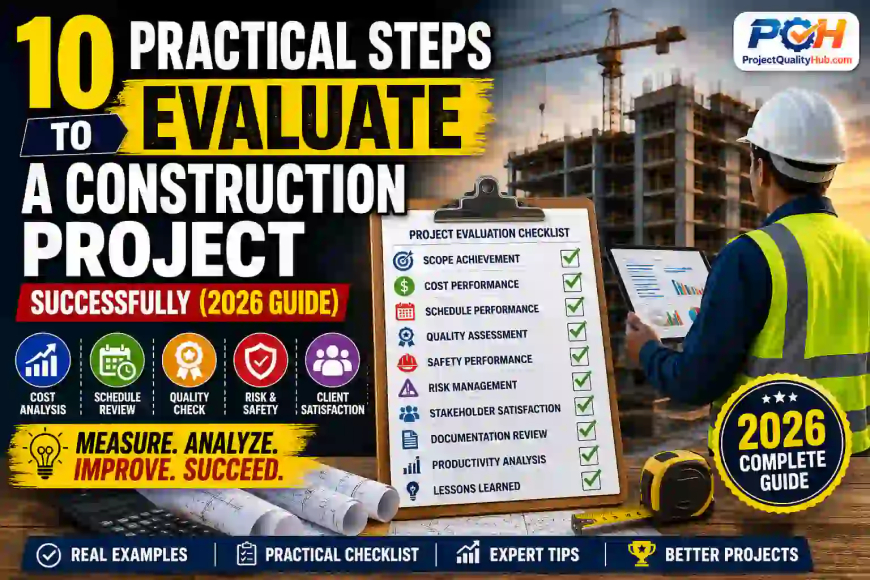
Most professional organizations evaluate projects based on these seven areas:
| Evaluation Area | Key Question |
|---|---|
| Scope | Was all planned work completed? |
| Cost | Did the project stay within budget? |
| Schedule | Was the project completed on time? |
| Quality | Did work meet specifications? |
| Safety | Were incidents minimized? |
| Risk | Were risks effectively controlled? |
| Stakeholder Satisfaction | Is the client satisfied? |
A successful project performs well in all seven categories.
Step-by-Step Process to Evaluate a Construction Project
Step 1: Review Project Objectives
Start by examining original project goals.
Questions to ask:
- What was promised?
- What was delivered?
- Were business objectives achieved?
Example:
A factory expansion project aimed to increase production capacity by 25%.
Evaluation Question:
Did the expansion actually increase capacity by 25%?
Step 2: Compare Planned vs Actual Schedule
Time performance is one of the easiest evaluation metrics.
Review:
- Baseline schedule
- Updated schedule
- Actual completion dates
Key indicators:
- Schedule Variance (SV)
- Planned vs Actual Progress
- Critical Path Delays
Example:
| Activity | Planned | Actual |
| Foundation | 30 Days | 35 Days |
| Structural Work | 60 Days | 70 Days |
| Finishing | 45 Days | 50 Days |
Result:
Project delayed by 20 days.
Step 3: Evaluate Cost Performance
Every project manager should ask:
"Did we spend more than planned?"
Review:
- Budget
- Approved variations
- Actual expenditure
- Claims and disputes
Important KPIs:
- Cost Variance (CV)
- Cost Performance Index (CPI)
- Cash Flow Performance
Example:
Budget = $5 Million
Actual Cost = $5.8 Million
Cost Overrun = $800,000
This indicates poor cost control.
Step 4: Assess Construction Quality
Quality evaluation determines whether the project meets technical requirements.
Review:
- Inspection reports
- Test certificates
- NCR records
- Punch list items
- Client observations
Quality Metrics:
- Rework Percentage
- Defect Rate
- First-Time Acceptance Rate
A project with excessive rework usually indicates planning or execution issues.
Construction Project Evaluation Checklist
Use this professional checklist:
Scope
- All deliverables completed
- Variations documented
- Contract scope fulfilled
Cost
- Budget maintained
- Claims settled
- Procurement controlled
Schedule
- Milestones achieved
- Critical delays analyzed
- Float consumption reviewed
Quality
- Inspection records approved
- Defects rectified
- Quality objectives achieved
Safety
- Lost Time Injuries (LTI)
- Near-miss reports
- Safety compliance
Documentation
- Drawings updated
- As-built records available
- Project files archived
Key Construction KPIs for Project Evaluation
| KPI | Purpose |
| Cost Performance Index (CPI) | Cost efficiency |
| Schedule Performance Index (SPI) | Schedule efficiency |
| Productivity Rate | Labor effectiveness |
| Accident Frequency Rate | Safety measurement |
| Rework Percentage | Quality measurement |
| Change Order Frequency | Scope control |
| Client Satisfaction Score | Customer success |
These KPIs provide measurable project performance data.
Real Construction Industry Example
Consider a commercial building project.
Initial Targets
- Budget: $10 Million
- Duration: 18 Months
- Zero major defects
- Lost Time Injury: Zero
Actual Results
- Cost: $10.7 Million
- Duration: 20 Months
- Minor defects: 15
- LTI: Zero
Evaluation
| Parameter | Result |
| Cost | Fair |
| Schedule | Poor |
| Quality | Good |
| Safety | Excellent |
Overall Rating:
Project successful but requires improvement in planning and schedule control.
This type of balanced evaluation gives management meaningful insights.
Advantages and Limitations of Construction Project Evaluation
| Advantages | Limitations |
| Improves future projects | Requires accurate data |
| Identifies weaknesses | Can be time-consuming |
| Supports decision-making | Subjective factors exist |
| Enhances accountability | Poor records reduce accuracy |
| Improves profitability | Requires skilled evaluators |
Common Mistakes When Evaluating a Construction Project
1. Focusing Only on Cost
A project under budget may still have poor quality.
2. Ignoring Client Satisfaction
The client ultimately defines project success.
3. Reviewing Only at Project Closeout
Evaluation should occur continuously.
4. Not Measuring Safety Performance
Safety is a major success indicator.
5. Poor Documentation
Incomplete records create inaccurate evaluations.
6. Ignoring Lessons Learned
Many companies collect lessons learned but never implement them.
Myths vs Facts
| Myth | Reality |
| Finished project means successful project | Not always |
| Budget is the only KPI | Multiple KPIs matter |
| Evaluation happens after completion | Continuous evaluation is best |
| Quality issues are minor | Quality affects lifecycle costs |
| Delays are normal | Delays should always be analyzed |
Expert Tips from Industry Practice
Pro Tip #1
Establish KPIs before construction starts.
Pro Tip #2
Conduct monthly project health reviews.
Pro Tip #3
Use digital dashboards for real-time monitoring.
Pro Tip #4
Track leading indicators, not only lagging indicators.
Pro Tip #5
Document lessons learned throughout execution.
Pro Tip #6
Include site engineers in evaluation discussions.
They often identify practical issues that management misses.
Future Trends in Construction Project Evaluation
The construction industry is rapidly adopting:
- AI-powered project analytics
- Digital twins
- Predictive scheduling
- BIM-based performance monitoring
- Drone progress tracking
- Real-time productivity measurement
- Automated quality inspections
These technologies are making project evaluations faster and more accurate.
Key Takeaways
- Construction project evaluation measures project success objectively.
- Cost, schedule, quality, safety, and client satisfaction must all be assessed.
- Evaluation should be continuous, not only at project completion.
- KPIs provide measurable project performance data.
- Lessons learned from evaluations improve future project outcomes.
- Successful evaluation helps organizations increase profitability and reduce risks.
Conclusion
If someone asks, "How do I evaluate a construction project?", the answer is simple:
You compare what was planned against what was actually achieved.
However, professional project evaluation goes much deeper than checking budgets and schedules. It requires reviewing quality, safety, risks, stakeholder satisfaction, productivity, and overall business objectives.
The best project managers treat evaluation as an ongoing process rather than a final report. By using structured KPIs, regular reviews, and lessons learned, you can consistently deliver better construction projects and avoid repeating costly mistakes.
Frequently Asked Questions (FAQs)
1. What is construction project evaluation?
Construction project evaluation is the process of assessing project performance against planned objectives related to scope, cost, schedule, quality, safety, and stakeholder satisfaction.
2. Why is project evaluation important in construction?
It helps identify strengths, weaknesses, risks, and improvement opportunities while ensuring project objectives are achieved.
3. What are the main criteria for evaluating a construction project?
The primary criteria are scope, cost, schedule, quality, safety, risk management, and client satisfaction.
4. What KPIs are used in construction project evaluation?
Common KPIs include CPI, SPI, productivity rate, rework percentage, accident frequency rate, and client satisfaction score.
5. When should a construction project be evaluated?
Evaluation should occur throughout the project lifecycle and during project closeout.
6. How do you measure project success?
Success is measured by comparing actual performance with project objectives and key performance indicators.
7. What is the biggest mistake in project evaluation?
Focusing only on cost and ignoring quality, safety, and client satisfaction.
8. Can a project be completed but still be unsuccessful?
Yes. A project can be completed but considered unsuccessful due to delays, poor quality, cost overruns, or dissatisfied stakeholders.
9. What tools help evaluate construction projects?
Primavera P6, Microsoft Project, BIM platforms, Power BI dashboards, and project management software are commonly used.
10. How often should project performance be reviewed?
Most organizations perform weekly and monthly reviews, with major evaluations at milestone completion.
Related Articles
- Cost Management Explained: Practical Guide for Projects
- Resource Management in Project Made Simple
- What is Resource Leveling?
- Risk Management in Project: Practical Guide
- Contract & Procurement Management: Save Cost, Time & Stress
- Project Execution Secrets: Why Projects Actually Fail
- Project Communication Secrets: Avoid Costly Mistakes
- Project Monitoring & Control Secrets: Control Delays & Cost