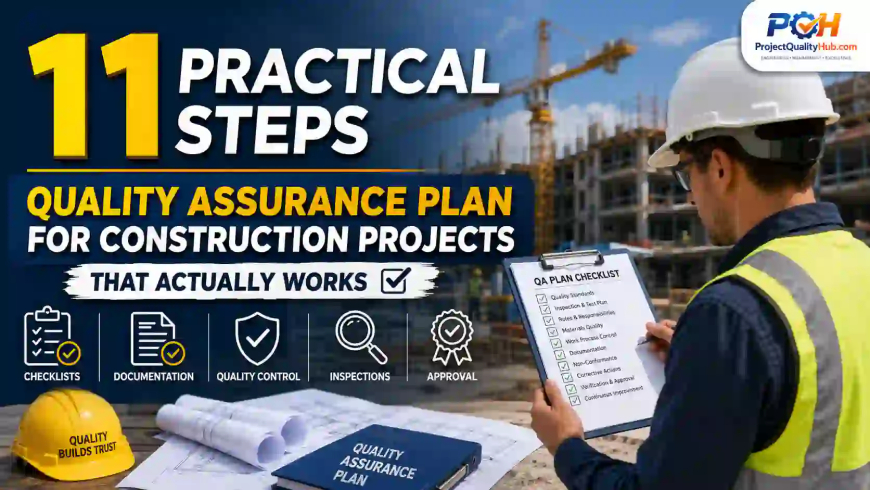
11 Practical Steps to Create a Quality Assurance Plan for a Construction Project That Actually Works
Learn what a quality assurance plan for a construction project is, why it matters, and how to create one with examples, checklist, and tips.
 Suraj Manikpuri
Introduction
Imagine this situation.
Concrete has already been poured. Shuttering is removed. Suddenly, the client’s engineer notices that the reinforcement spacing is not as per approved drawing.
Now what?
Breaking, repairing, delay, cost impact, blame game — sab kuch start ho jata hai.
This is exactly why a quality assurance plan for a construction project is required before work starts. A good QA plan does not wait for mistakes to happen. It creates a system so mistakes are prevented, checked, recorded, corrected, and not repeated.
Many beginners think quality assurance means only site inspection. But in real construction, quality assurance is much bigger. It includes planning, approvals, material control, inspection, testing, documentation, audits, NCR management, and final handover records.
In this guide, you will learn what a construction quality assurance plan is, why it is important, what it includes, how to prepare it step by step, and how engineers use it practically on site.
What Is a Quality Assurance Plan for a Construction Project?
A Quality Assurance Plan, also called a QA Plan, QA/QC Plan, or Project Quality Plan, is a formal document that explains how quality will be planned, controlled, inspected, tested, recorded, and improved during a construction project.
In simple words, it answers:
- What quality standards will be followed?
- Who is responsible for quality?
- Which materials need approval?
- What inspections and tests are required?
- When should inspection be done?
- What documents must be maintained?
- What happens if work is rejected?
- How will final quality records be submitted?
A QA plan works like a roadmap for quality.
For example, if you are constructing a building foundation, the QA plan will define how soil compaction will be checked, how reinforcement will be inspected, how concrete cube tests will be taken, how waterproofing will be verified, and how records will be submitted to the client.
Why Is a Quality Assurance Plan Important in Construction?
Construction projects involve many activities, people, materials, and agencies. Without a proper quality system, mistakes easily happen.
A QA plan is important because it helps to:
- Prevent poor workmanship
- Reduce rework and repair cost
- Avoid delay due to rejected work
- Maintain compliance with drawings and specifications
- Improve coordination between contractor, consultant, client, and subcontractors
- Provide traceable records for future reference
- Support smooth billing and handover
- Improve safety and durability of the structure
Real-life example:
On one project, the site team started block masonry without checking the approved block type, mortar ratio, and wall alignment requirement. After inspection, a large portion was rejected. If a proper QA plan and checklist had been followed, the team would have checked material approval, line-dori, level, thickness, and curing requirements before starting the activity.
Quality assurance is not extra paperwork. It saves money when used correctly.
Quality Assurance vs Quality Control in Construction
Many people use QA and QC as the same word, but both are different.
| Point | Quality Assurance | Quality Control |
|---|---|---|
| Meaning | Preventive system | Inspection and testing system |
| Focus | Process quality | Product/work quality |
| Timing | Before and during work | During and after work |
| Example | Method statement, ITP, audit | Cube test, alignment check, welding inspection |
| Goal | Avoid defects | Find and correct defects |
Simple explanation:
QA asks: Are we following the right process?
QC asks: Is the completed work acceptable?
Both are required. QA without QC becomes theory. QC without QA becomes firefighting.
Main Components of a Construction Quality Assurance Plan
A good construction QA plan should include the following components:
1. Project Quality Policy
This section explains the project’s quality commitment. It should clearly state that all work will be executed as per approved drawings, specifications, codes, standards, and contractual requirements.
2. Scope of Work
Mention the project scope covered under the QA plan, such as civil works, structural steel, mechanical works, electrical works, finishing works, waterproofing, road works, or infrastructure works.
3. Applicable Standards and Specifications
List the codes, standards, contract specifications, approved drawings, manufacturer instructions, and client requirements applicable to the project.
Examples:
- Approved construction drawings
- Technical specifications
- BOQ requirements
- Relevant national or international codes
- Manufacturer recommendations
- Client quality requirements
4. Quality Organization Chart
Define the quality team structure.
Typical roles:
- Project Manager
- Construction Manager
- QA/QC Manager
- QA/QC Engineer
- Site Engineer
- Lab Technician
- Surveyor
- Store In-charge
- Subcontractor Quality Representative
5. Roles and Responsibilities
Clearly define who will do what.
For example:
- Site Engineer: Execute work as per approved drawings
- QA/QC Engineer: Conduct inspection and maintain records
- Store In-charge: Ensure only approved materials are issued
- Project Manager: Ensure resources and compliance
- Subcontractor: Follow approved method statement and ITP
6. Material Approval System
This section explains how materials will be submitted, reviewed, approved, received, stored, and inspected.
Important records:
- Material Approval Request
- Manufacturer test certificate
- Third-party test report
- Delivery challan
- Material inspection report
- Storage inspection checklist
7. Method Statements
A method statement explains how a specific construction activity will be performed safely and correctly.
Examples:
- Excavation method statement
- Concrete pouring method statement
- Rebar fixing method statement
- Waterproofing method statement
- Structural steel erection method statement
- Painting method statement
8. Inspection and Test Plan
The Inspection and Test Plan, or ITP, is one of the most important parts of the QA plan.
It defines:
- Activity stages
- Inspection requirements
- Testing requirements
- Acceptance criteria
- Responsible person
- Inspection frequency
- Hold points and witness points
- Required formats and records
9. Document Control
Construction quality depends heavily on using the latest approved documents.
Document control ensures that outdated drawings, superseded specifications, and unapproved formats are not used at site.
10. Non-Conformance and Corrective Action
If work does not meet requirements, it is recorded as a Non-Conformance Report, commonly called NCR.
The QA plan should explain how NCRs are raised, reviewed, corrected, closed, and analyzed to prevent recurrence.
11. Internal Audit and Review
Quality audits help verify whether the project team is following the approved QA plan, ITPs, procedures, and documentation system.
Advantages and Limitations of a Quality Assurance Plan
Advantages
- Reduces defects and rework
- Improves client confidence
- Creates clear responsibilities
- Helps in billing and handover
- Supports contractual compliance
- Improves team coordination
- Provides evidence during disputes
- Improves long-term durability
Limitations
A QA plan can fail if:
- It is copied from another project without customization
- Site team does not follow it
- Checklists are filled without actual inspection
- Testing is delayed
- Records are not maintained properly
- Management focuses only on progress, not quality
- Subcontractors are not trained
Remember: A QA plan is not magic. It works only when implemented honestly.
Common Mistakes in Construction Quality Assurance Plans
1. Copy-Paste QA Plan
Many contractors copy old QA plans and change only the project name. This creates mismatch with actual project requirements.
2. No Clear Responsibility
If responsibility is not defined, everyone assumes someone else will check the work.
3. Weak Material Control
Using unapproved material is one of the biggest quality risks in construction.
4. Inspection After Completion Only
Quality should be checked stage by stage, not only after work is completed.
5. Poor Documentation
If records are missing, even good work becomes difficult to prove.
6. Ignoring NCR Root Cause
Closing NCR without root-cause analysis means the same mistake will happen again.
7. No Training for Site Team
A QA plan kept only in the office file is useless. Supervisors and engineers must understand it.
Myths vs Facts About Quality Assurance Plans
| Myth | Fact |
| QA plan is only for big projects | Even small projects need quality planning |
| QA is only QA/QC engineer’s job | Quality is everyone’s responsibility |
| More documents mean better quality | Useful documents and proper implementation matter |
| Inspection slows down work | Planned inspection prevents bigger delays |
| Quality starts after work completion | Quality starts before procurement and execution |
| NCR means failure | NCR is a tool for correction and improvement |
Expert Tips to Make a QA Plan Actually Work
Here are practical tips from real construction experience:
- Keep the QA plan project-specific.
- Prepare activity-wise ITPs before work starts.
- Use simple checklists that supervisors can understand.
- Do internal inspection before calling the client.
- Maintain latest approved drawings at site.
- Control material approval strictly.
- Keep calibration certificates updated.
- Train subcontractors before starting critical work.
- Track NCR trends weekly.
- Create a final quality dossier index from the beginning.
Pro tip: Do not wait until project completion to collect quality records. Maintain them daily. Final handover becomes much easier.
Conclusion
A quality assurance plan for a construction project is not just a document made for client approval. It is a working system that protects the project from defects, rework, delay, and unnecessary cost.
When prepared properly, it gives clarity to everyone — project manager, QA/QC engineer, site engineer, subcontractor, consultant, and client.
The best QA plans are simple, practical, and site-focused. They tell the team what to check, when to check, how to check, who will approve, and what record must be maintained.
In construction, quality is not achieved by inspection alone. Quality is achieved by planning well, executing carefully, checking honestly, correcting quickly, and learning continuously.
FAQs
1. What is a quality assurance plan in construction?
A quality assurance plan in construction is a project-specific document that explains how quality requirements will be achieved through approved procedures, inspections, tests, responsibilities, records, audits, and corrective actions.
2. What is included in a construction QA plan?
A construction QA plan usually includes project quality policy, scope, standards, organization chart, roles and responsibilities, material control, method statements, ITPs, inspection procedures, testing requirements, NCR process, audit plan, and handover documentation.
3. What is the difference between QA plan and QC plan?
A QA plan focuses on preventing defects through proper processes and planning. A QC plan focuses on checking and testing completed work to confirm whether it meets the required specifications.
4. Who prepares the quality assurance plan for a construction project?
Usually, the QA/QC Manager or QA/QC Engineer prepares the QA plan with input from the Project Manager, Construction Manager, planning team, procurement team, and site engineers.
5. Why is an Inspection and Test Plan important?
An Inspection and Test Plan is important because it defines what inspection or test is required at each stage of work, who will perform it, what acceptance criteria apply, and what records must be maintained.