Magnetic & Density Separation Equipment for Laboratory Testing
Learn how magnetic & density separation equipment improves sample preparation accuracy in industrial R&D and QC laboratories.
 Suraj Manikpuri
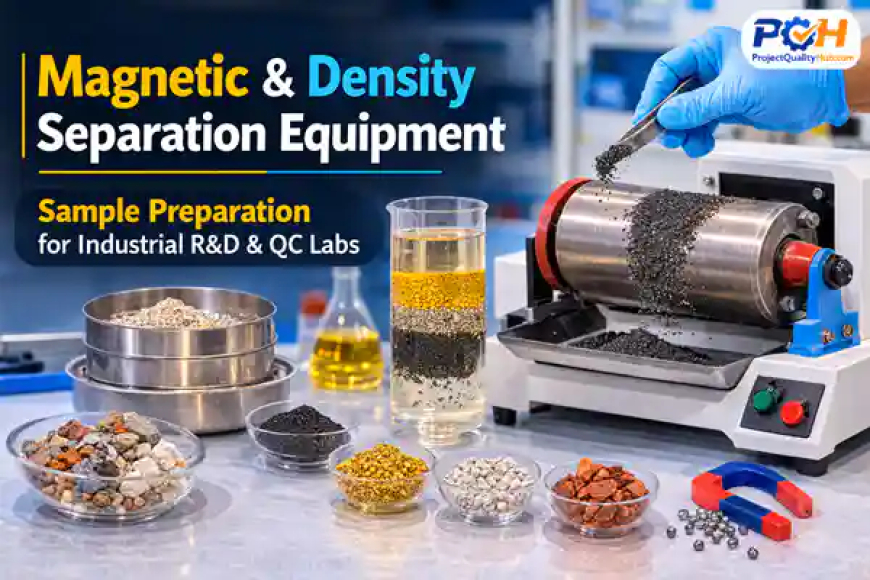
Introduction: The Hidden Step That Makes Laboratory Testing More Accurate
A few years ago, while visiting a mineral testing laboratory, I noticed something interesting.
The engineers were not just crushing, grinding, or sieving samples. They were also separating materials using magnets and density methods before analysis.
At first glance it looked simple. But when I asked the lab engineer, he explained something important:
“If we don’t separate the magnetic and non-magnetic minerals first, the chemical analysis can become misleading.”
That moment made it clear how important Magnetic & Density Separation Equipment is in industrial R&D and QC laboratories.
In many industries like mining, steel, mineral processing, and metallurgy, samples often contain mixed minerals or materials.
To analyze them properly, labs must separate the components first.
And that’s exactly what magnetic and density separation equipment does.
What is Magnetic & Density Separation Equipment?
Magnetic & density separation equipment refers to laboratory machines used to separate materials based on their magnetic properties or density differences.
This step is commonly used during advanced sample preparation in industrial laboratories.
The main goal is simple:
Separate different materials in a sample before performing chemical or physical analysis.
For example:
A mineral sample may contain:
-
Iron minerals (magnetic)
-
Silica (non-magnetic)
-
Heavy minerals
-
Light minerals
Using magnetic or density separation, each component can be isolated and analyzed separately.
Why Magnetic & Density Separation is Important in Industrial Labs
This step may seem optional, but in many laboratories it is essential for accurate analysis.
1. Improves Analytical Accuracy
Separating materials ensures each component is analyzed individually.
2. Identifies Mineral Composition
Mining and geology labs use separation techniques to understand ore composition.
3. Removes Contaminants
Magnetic separation can remove metal contamination from samples.
4. Supports Mineral Beneficiation Studies
R&D labs use these methods to study ore processing efficiency.
Types of Magnetic & Density Separation Equipment Used in Laboratories
Different materials require different separation techniques.
Let’s explore the most commonly used equipment in industrial labs.
1. Laboratory Magnetic Separators
Magnetic separators are widely used in mineral processing and metallurgy laboratories.
How They Work
These machines use magnetic fields to separate magnetic materials from non-magnetic materials.
Best For
-
Iron ore samples
-
Magnetite separation
-
Removing metallic contamination
Example
In iron ore laboratories, magnetic separators help isolate magnetite particles from gangue materials.
2. Frantz Magnetic Separator
The Frantz Isodynamic Magnetic Separator is commonly used in geological laboratories.
Features
-
Adjustable magnetic field
-
Precise mineral separation
-
High accuracy
Best For
-
Geological studies
-
Mineral research labs
-
Rare earth mineral separation
3. Heavy Liquid Separation Equipment
Density separation can also be done using heavy liquids.
These liquids have high density, allowing heavier minerals to sink and lighter minerals to float.
Best For
-
Mineral analysis
-
Geological sample preparation
-
Rare mineral identification
Example
Zircon, monazite, and other heavy minerals can be separated using this method.
4. Shaking Tables
Shaking tables use gravity and motion to separate materials based on density.
Best For
-
Mineral beneficiation studies
-
Gold ore analysis
-
Heavy mineral separation
Advantage
Provides visual separation of particles based on density differences.
Real-Life Example: Magnetic Separation in a Mining Laboratory
Let’s take a practical example from a mineral processing lab.
A mining company sends a mixed ore sample containing:
-
Magnetite
-
Quartz
-
Other minerals
The laboratory process looks like this:
Step 1 → Sample crushing
Step 2 → Grinding into fine powder
Step 3 → Magnetic separation using laboratory separator
Step 4 → Separate fractions analyzed individually
The results help engineers determine:
-
Ore grade
-
Processing efficiency
-
Mineral recovery potential
Without magnetic separation, the analysis would not accurately represent the ore composition.
Step-by-Step Sample Preparation Using Magnetic Separation
Here’s how laboratories typically perform magnetic separation.
Step 1: Sample Crushing and Grinding
The sample must first be reduced to fine particles.
Step 2: Drying the Sample
Moisture may interfere with separation.
Step 3: Feeding the Sample into Magnetic Separator
The machine applies a controlled magnetic field.
Step 4: Separation of Magnetic and Non-Magnetic Fractions
Different materials move into separate collection trays.
Step 5: Analysis of Each Fraction
Each separated component can be tested independently.
Advantages of Magnetic & Density Separation Equipment
1. Highly Accurate Mineral Separation
Allows detailed study of mineral composition.
2. Improves Sample Purity
Removes unwanted materials from samples.
3. Essential for Mineral Processing Research
Widely used in mining R&D.
4. Supports Advanced Analytical Techniques
Improves results in chemical and mineralogical analysis.
Disadvantages of Magnetic & Density Separation
1. Limited to Specific Materials
Magnetic separation only works for magnetic minerals.
2. Requires Skilled Operation
Incorrect settings can affect separation accuracy.
3. Time Consuming
Multiple separation steps may be required.
4. Equipment Cost
Advanced separators can be expensive.
Common Mistakes in Laboratory Separation
Even experienced lab technicians sometimes make these mistakes.
1. Using Incorrect Magnetic Strength
Different minerals require different magnetic field strengths.
2. Improper Sample Grinding
Large particles reduce separation efficiency.
3. Moisture in Samples
Wet samples can interfere with separation.
4. Mixing Separated Fractions
Improper handling may contaminate results.
Expert Tips from Industrial Laboratories
Here are some practical tips used by experienced laboratory engineers.
✔ Always Standardize Sample Size
Uniform particle size improves separation efficiency.
✔ Adjust Magnetic Field Carefully
Different minerals respond to different magnetic strengths.
✔ Clean Equipment Between Samples
Prevents cross contamination.
✔ Use Proper Safety Measures
Heavy liquids used in density separation may require careful handling.
✔ Document Separation Results
Maintain proper laboratory records for reproducibility.
Conclusion: Magnetic & Density Separation Equipment Enhances Laboratory Accuracy
When preparing samples for laboratory testing, crushing, grinding, and sieving are only the beginning.
In many industries, especially mining, metallurgy, and mineral processing, accurate results require one more step — Magnetic & Density Separation.
These techniques allow laboratories to separate materials based on magnetic properties or density, helping engineers understand the true composition of samples.
The result?
Better research, better quality control, and better industrial decisions.
So the next time you see a magnetic separator working in a lab, remember:
It’s quietly revealing the hidden structure of the material being tested.
Frequently Asked Questions (FAQs)
1. What is magnetic separation in laboratory sample preparation?
Magnetic separation is a process that uses magnetic fields to separate magnetic minerals from non-magnetic materials.
2. What is density separation?
Density separation separates materials based on differences in particle density using gravity or heavy liquids.
3. Which industries use magnetic separation equipment?
Industries include mining, metallurgy, mineral processing, and geological research laboratories.
4. What equipment is used for magnetic separation in laboratories?
Common equipment includes laboratory magnetic separators, Frantz separators, and shaking tables.
5. Why is separation important in mineral testing?
It allows laboratories to analyze individual minerals separately for more accurate results.