5 Why Analysis in Six Sigma (Simple Practical Guide)
Learn 5 Why Analysis in Six Sigma with real examples, step-by-step guide, mistakes, and expert tips to find root causes effectively.
 Suraj Manikpuri
🚀 Introduction: Why Problems Keep Coming Back?
Have you ever fixed a problem… only to see it come back again after a few days?
In plant operations, project execution, or even daily life — this happens a lot. We treat the symptom, not the real cause.
This is exactly where 5 Why Analysis in Six Sigma becomes powerful.
I’ve personally used this technique during equipment failures and project delays. And trust me — many times the real issue was something completely unexpected.
Simple language mein:
👉 “Problem ka asli root pakdo, warna problem wapas aayega.”
Let’s break it down in the simplest way possible.
🔍 What is 5 Why Analysis in Six Sigma?
5 Why Analysis is a simple yet powerful root cause analysis technique used in Six Sigma and Lean methodologies.
👉 The idea is straightforward:
Ask “Why?” repeatedly (typically 5 times) until you reach the root cause of a problem.
It was originally developed by Toyota for manufacturing problem-solving.
🧠 Why “5” Whys?
Honestly, it’s not always exactly 5.
- Sometimes you find the root cause in 3 Whys
- Sometimes it takes 7 or more
“5” is just a practical benchmark.
👉 Goal = Go deep enough to reach the real cause
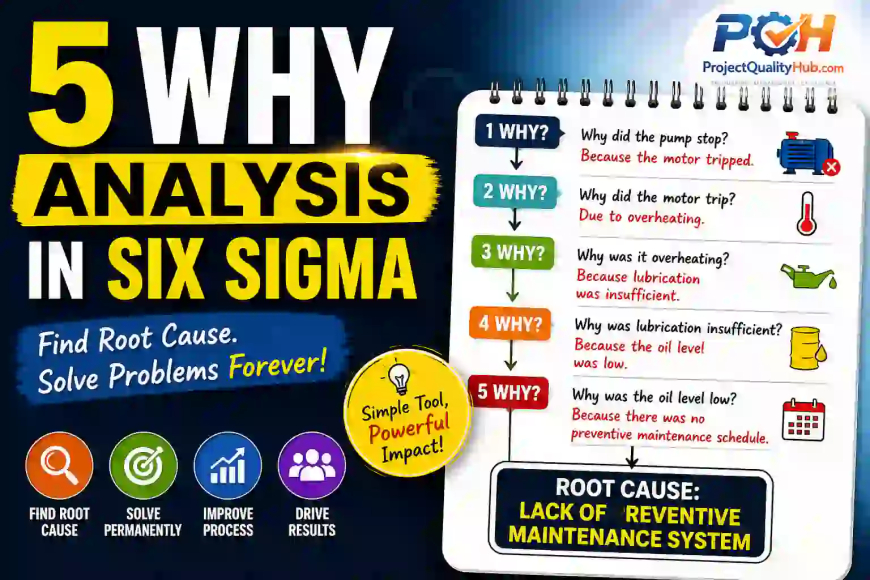
🏭 Real-Life Example (From Industry)
Let’s take a steel plant scenario — something very relatable.
❌ Problem:
High-pressure pump stopped working.
🔎 5 Why Analysis:
- Why did the pump stop?
→ Because the motor tripped. - Why did the motor trip?
→ Due to overheating. - Why was it overheating?
→ Because lubrication was insufficient. - Why was lubrication insufficient?
→ Because the oil level was low. - Why was the oil level low?
→ Because there was no preventive maintenance schedule.
👉 Root Cause: Lack of preventive maintenance system
💡 Lesson:
Machine failure nahi tha — system failure tha.
📊 Step-by-Step Guide: How to Do 5 Why Analysis
Step 1: Clearly Define the Problem
Avoid vague statements.
❌ “Machine not working”
✅ “Pump stopped during operation at 2 PM due to motor trip”
Step 2: Ask First “Why”
Focus on facts, not assumptions.
Step 3: Keep Asking Why
Each answer becomes the next question.
👉 Don’t jump to conclusions early.
Step 4: Identify Root Cause
Stop when:
- You reach a process/system issue
- Further “why” doesn’t add value
Step 5: Take Corrective Action
Fix the root cause — not the symptom.
Step 6: Verify Effectiveness
Check if problem reoccurs or not.
🛠️ Practical Use Cases
1. Manufacturing
- Machine breakdown
- Quality defects
2. Construction Projects
- Delay in activity
- Cost overrun
3. IT & Software
- System crashes
- Bug recurrence
4. Daily Life 😄
- Late to office
- Missed deadlines
✅ Advantages of 5 Why Analysis
✔ Simple and easy to use
✔ No special tools required
✔ Identifies real root cause
✔ Improves problem-solving skills
✔ Great for team discussions
❌ Disadvantages / Limitations
⚠ Depends on team knowledge
⚠ Can lead to wrong conclusions if biased
⚠ Not suitable for complex problems alone
⚠ May oversimplify technical issues
👉 Pro Tip: Combine with Fishbone Diagram (Ishikawa) for better accuracy.
🚫 Common Mistakes to Avoid
1. Jumping to Conclusions
First answer hi final maan lena — biggest mistake.
2. Blaming People Instead of Process
❌ “Operator mistake”
✅ “Training system inadequate”
3. Stopping Too Early
3 Why pe ruk gaye — root cause miss ho gaya.
4. No Data Validation
Guesswork ≠ Root cause
5. No Action Taken
Analysis kiya but action nahi liya → Waste effort
💡 Expert Tips (From Real Experience)
👉 Always involve cross-functional team
👉 Use actual data and logs
👉 Write answers clearly (don’t keep in mind)
👉 Combine with other tools (Pareto, Fishbone)
👉 Focus on process improvement, not blame
Ek simple rule yaad rakho:
👉 “Fix the system, not the person.”
🔥 Conclusion: Simple Tool, Powerful Impact
5 Why Analysis in Six Sigma is one of the simplest yet most effective tools to solve problems permanently.
It doesn’t require software, certifications, or complex formulas — just the right mindset.
If you use it properly:
✔ Problems reduce
✔ Efficiency improves
✔ Systems become stronger
Next time when a problem occurs, don’t rush to fix it.
Pause and ask:
👉 “Why did this actually happen?”
❓ FAQs (Frequently Asked Questions)
1. Is 5 Why Analysis only for Six Sigma?
No. It can be used in any field — manufacturing, IT, construction, or even personal life.
2. Can I use more than 5 Whys?
Yes. “5” is just a guideline. Use as many as needed.
3. What is the main goal of 5 Why Analysis?
To identify the root cause, not just symptoms.
4. Is 5 Why enough for complex problems?
Not always. Combine it with tools like Fishbone Diagram or FMEA.
5. Who should perform 5 Why Analysis?
A team with knowledge of the process — engineers, operators, supervisors.
6. What is the biggest mistake in 5 Why?
Stopping too early or blaming individuals instead of system issues.