Check Sheet in Six Sigma Explained with Examples
Learn Check Sheet in Six Sigma with examples, types & step-by-step guide. Improve quality using simple data collection tool.
 Suraj Manikpuri
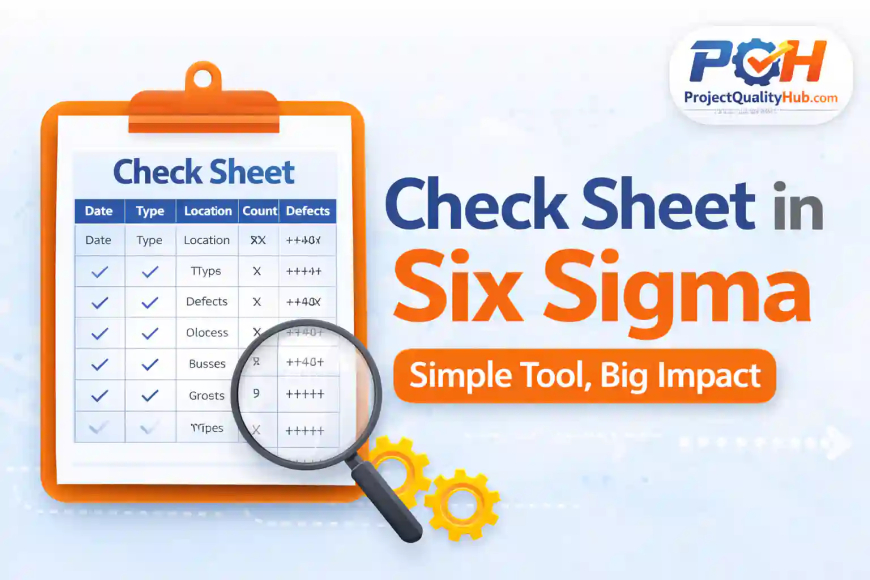
Introduction: The Day We Stopped Guessing
On one of my site projects, we were facing repeated defects in fabrication.
Everyone had opinions:
“Machine issue hoga…”
“Operator mistake hai…”
“Material problem hai…”
But honestly, sab guess kar rahe the.
Then we used a Check Sheet in Six Sigma.
Within 2 days, reality saamne aa gayi —
👉 70% defects ek hi shift mein ho rahe the.
No guesswork. Only data.
That’s when I realized:
Simple tools, when used correctly, can beat complex analysis.
What is a Check Sheet in Six Sigma?
A Check Sheet is a structured form used to collect and record data in real-time.
👉 Simple language mein:
“Data collect karne ka easy aur systematic tareeka.”
It is one of the 7 basic quality tools used in Six Sigma and Lean.
Why Check Sheet is Important?
Before improving anything, you need to understand the problem.
And understanding comes from data, not assumptions.
Key Benefits:
- Real-time data collection
- Easy to use (no technical skill required)
- Helps identify patterns
- Supports decision-making
- Reduces guesswork
👉 Truth:
Without data, improvement is just opinion.
Types of Check Sheets (With Examples)


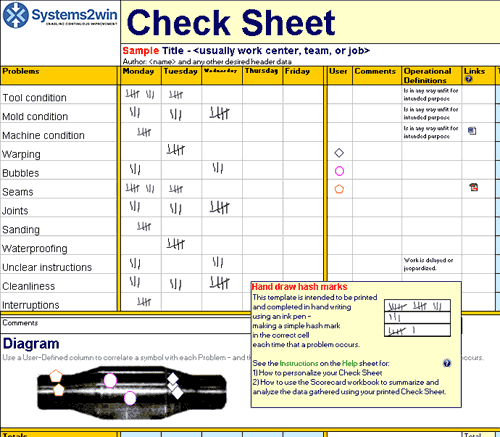
1. Frequency Check Sheet
Counts how many times something happens.
👉 Example:
Number of defects per shift
2. Defect Type Check Sheet
Tracks types of defects.
👉 Example:
Crack, dent, misalignment
3. Defect Location Check Sheet
Shows where defects occur.
👉 Example:
Pipeline section, plate area, weld joint
4. Cause Classification Check Sheet
Tracks root causes.
👉 Example:
Machine issue, operator error, material defect
Real-Life Example (From Site Experience)
In a pressure piping project:
Problem:
Leakage in hydro test
Action:
We created a Check Sheet
Data Collected:
- Weld joint number
- Welder name
- Type of defect
Result:
👉 80% leakage from welds done by new welders
Action Taken:
- Additional training
- Supervision improved
👉 Outcome:
Leakage reduced drastically
Step-by-Step Guide: How to Create a Check Sheet
Step 1: Define Objective
What do you want to track?
👉 Example: Defects, delays, failures
Step 2: Decide Categories
What types of data you need?
👉 Example:
- Type of defect
- Location
- Time
Step 3: Design the Format
Create a simple table:
| Date | Type | Location | Count |
|---|
👉 Keep it simple. Fancy mat banao.
Step 4: Train the Team
Ensure everyone understands:
- What to record
- How to record
Step 5: Collect Data
Start recording in real-time.
👉 Important:
Consistency is key.
Step 6: Analyze Data
After few days:
- Identify patterns
- Find major issues
👉 This leads to root cause analysis.
Advantages of Check Sheet
✔ Easy to create and use
✔ No technical knowledge required
✔ Helps in data-driven decisions
✔ Improves process visibility
✔ Supports other tools (Pareto, Fishbone)
Disadvantages (Reality Check)
❌ Limited to basic data collection
❌ Depends on human accuracy
❌ Not suitable for complex analysis
❌ Requires discipline in data entry
Common Mistakes (Avoid These)
- Collecting unnecessary data
- Poorly designed format
- No training to team
- Inconsistent data entry
- Not analyzing collected data
👉 Sabse bada mistake:
Data collect karke use na karna
Myths About Check Sheet
❌ “Ye basic tool hai, useful nahi hai”
✔ Reality: Most powerful tools are simple
❌ “Software ke bina kaam nahi chalega”
✔ Reality: Paper bhi enough hai
Expert Tips (From Real Projects)
⭐ Start with pen & paper
⭐ Keep format clean and simple
⭐ Focus on key data only
⭐ Review data daily
⭐ Combine with Pareto chart
👉 Pro Tip:
If your check sheet is complicated, people won’t use it.
Conclusion: Small Tool, Big Impact
The Check Sheet in Six Sigma may look simple, but its impact is huge.
It helps you:
- Move from guesswork to data
- Identify real problems
- Make better decisions
Agar aap improvement chahte ho…
Start with data.
And the easiest way to start?
👉 Use a Check Sheet.
FAQs
1. What is a Check Sheet in Six Sigma?
It is a structured form used to collect and record data systematically.
2. Where is Check Sheet used?
Used in manufacturing, construction, healthcare, and service industries.
3. Is Check Sheet a statistical tool?
No, it is a basic data collection tool.
4. What is the difference between Check Sheet and Checklist?
Check Sheet collects data, checklist ensures task completion.
5. Can Check Sheet be digital?
Yes, it can be created in Excel or software tools.
Related Articles
- Six Sigma Certification Guide: Levels, Benefits & Career
- Top Certification Courses for Quality Engineers in India (2026)
- Lean Six Sigma White Belt: Beginner Guide
- Six Sigma DMAIC Model Explained in Simple words
- SIPOC Diagram in Six Sigma Explained Simply