Step-by-Step Guide to Effective Planning & Scheduling
Learn Planning & scheduling which sound like big management terms, but the idea is actually simple: decide the work first, then decide the timeline.
 Suraj Manikpuri
Whether you're managing a construction project, engineering work, startup task, or even exam preparation, the same structured approach works.
Let’s walk through a practical step-by-step process used by professional project managers.
Step 1: Define the Project Goal Clearly
Every good plan starts with a clear objective.
Ask yourself:
-
What exactly needs to be achieved?
-
What is the expected outcome?
-
What is the deadline?
For example, in an engineering project:
Install a high-pressure pump system and complete commissioning within 45 days.
If the goal is vague, the plan will also be vague. So clarity is the first step of planning.
Step 2: Break the Project into Smaller Tasks (WBS)
Large projects look overwhelming until you break them into smaller manageable tasks.
This process is called Work Breakdown Structure (WBS).
Example for pump installation:
-
Site preparation
-
Civil foundation work
-
Pump delivery
-
Mechanical installation
-
Electrical connection
-
Pipeline installation
-
Testing and commissioning
Instead of one big project, you now have 7 clear activities.
This makes planning easier and more accurate.
Step 3: Identify Task Dependencies
Not every task can start at the same time.
Some tasks depend on others.
Example:
-
Pump installation cannot start before foundation is ready
-
Electrical wiring cannot start before equipment installation
These are called task dependencies.
Understanding dependencies prevents scheduling mistakes and delays.
Step 4: Estimate Time for Each Task
Now estimate how long each activity will take.
Try to base estimates on experience or past data, not guesswork.
Example:
| Task | Estimated Duration |
|---|---|
| Site preparation | 3 days |
| Foundation work | 7 days |
| Pump delivery | 10 days |
| Mechanical installation | 4 days |
| Electrical work | 3 days |
| Testing & commissioning | 2 days |
Accurate estimation is critical for a reliable schedule.
Step 5: Assign Resources
Planning is incomplete without assigning resources.
Resources include:
-
Engineers
-
Technicians
-
Contractors
-
Machinery
-
Materials
For example:
-
Civil contractor → foundation work
-
Mechanical team → pump installation
-
Electrical team → wiring and testing
Clear responsibility avoids confusion during execution.
Step 6: Create the Project Schedule
Now convert tasks into a timeline.
This is where scheduling begins.
The most common method is a Gantt Chart, which visually shows:
-
Start date
-
End date
-
Task sequence
-
Dependencies
Example timeline:
Day 1–3 → Site preparation
Day 4–10 → Foundation work
Day 11–20 → Pump delivery
Day 21–25 → Installation
Day 26–28 → Electrical work
Day 29–30 → Testing
Now the project timeline becomes clear.
Step 7: Identify the Critical Path
In every project, some tasks are more important than others.
The critical path is the sequence of activities that determines the minimum project duration.
If any critical task gets delayed, the entire project gets delayed.
Example critical path:
Foundation → Pump delivery → Installation → Testing
Smart project managers always monitor these activities closely.
Step 8: Add Buffer Time
Real projects rarely go exactly as planned.
There may be:
-
Weather delays
-
Material shortages
-
Equipment breakdowns
-
Approval delays
That’s why professionals add buffer time (contingency).
Example:
If installation takes 4 days, schedule 5 days.
This small buffer protects the project schedule.
Step 9: Monitor Progress Regularly
Planning & scheduling do not end after creating a plan.
They require continuous monitoring.
Good practice:
-
Weekly progress review
-
Compare planned vs actual progress
-
Update schedule if needed
This process is called schedule control.
Step 10: Communicate the Schedule to the Team
Even the best schedule fails if the team doesn’t understand it.
So always:
-
Share the schedule with all stakeholders
-
Conduct coordination meetings
-
Clarify responsibilities
When everyone knows what to do and when, projects run smoothly.
Simple Real-Life Example
Imagine organizing a college technical event.
Planning includes:
-
Deciding event theme
-
Booking auditorium
-
Inviting speakers
-
Arranging equipment
Scheduling includes:
-
Promotion → Week 1
-
Registrations → Week 2
-
Final preparation → Week 3
-
Event execution → Week 4
With proper planning & scheduling, the event becomes organized instead of stressful.
Quick Summary
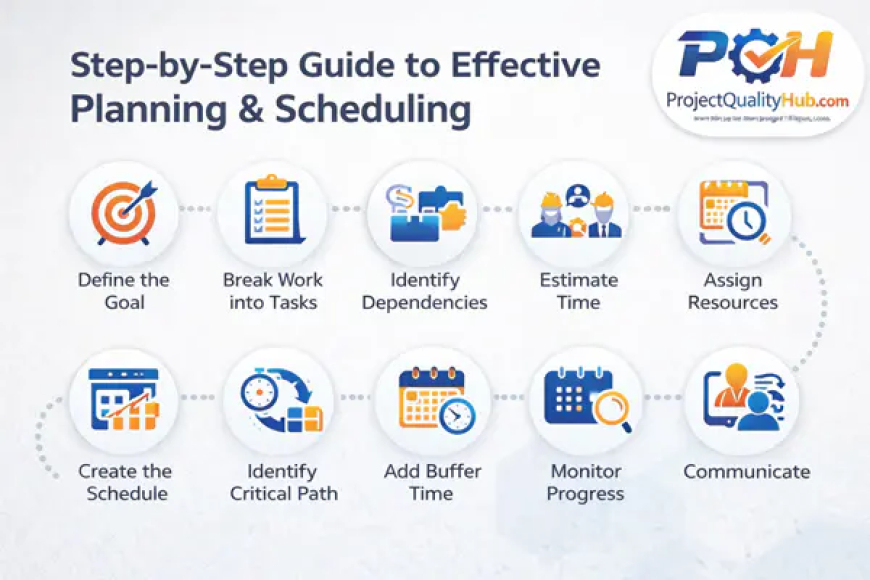
Effective planning & scheduling follow this simple flow:
-
Define the goal
-
Break work into tasks (WBS)
-
Identify dependencies
-
Estimate task duration
-
Assign resources
-
Create the schedule
-
Identify the critical path
-
Add buffer time
-
Monitor progress
-
Communicate with the team
When done correctly, even complex projects become manageable and predictable.