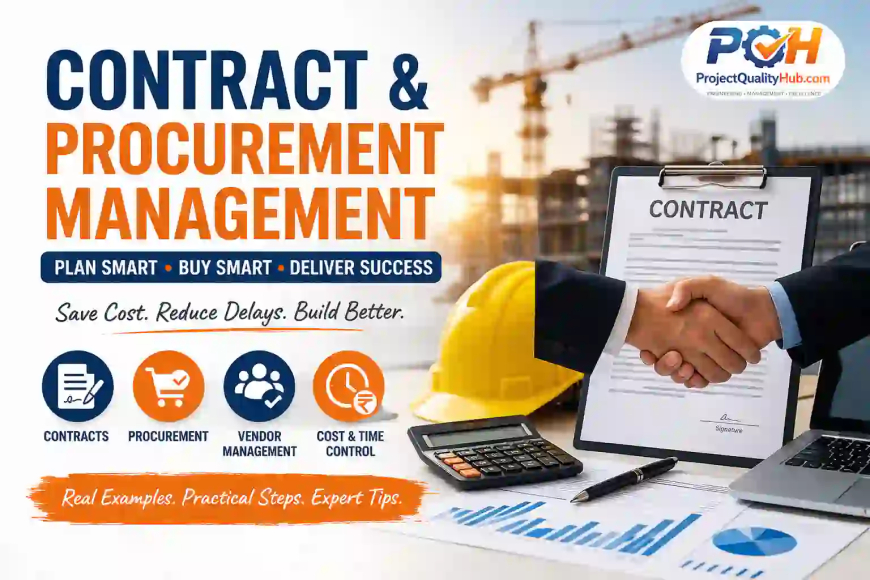
Contract & Procurement Management: Save Cost, Time & Stress
Master contract & procurement management with practical steps, real examples, and expert tips to avoid delays and cost overruns.
 Suraj Manikpuri
Contract & Procurement Management: The Hidden Power Behind Successful Projects
Introduction: What Really Goes Wrong in Projects?
If you’ve worked on any project, you’ve probably seen this:
- Project delayed
- Budget exceeded
- Vendor not delivering on time
And then… endless blame game.
From real site experience, the root cause in most cases is weak Contract & Procurement Management.
I’ve personally seen situations where everything was ready—equipment, manpower, site—but a small gap in contract terms or late procurement caused major delays.
Let’s be honest—yeh koi paperwork ka kaam nahi hai.
It’s the backbone of project success.
📘 What is Contract & Procurement Management?
🔹 Simple Definition
Contract & Procurement Management is the process of:
- Selecting the right vendor
- Defining clear terms and conditions
- Ensuring timely delivery
- Monitoring performance as per contract
👉 In simple words:
Right product/service, right price, right time, right quality
🔄 Procurement vs Contract Management (Clear Difference)
| Aspect | Procurement | Contract Management |
|---|---|---|
| Focus | Purchasing process | Contract execution |
| Stage | Before contract | After contract |
| Goal | Vendor selection | Performance control |
| Example | RFQ, bidding | Payment, claims, penalties |
👉 Easy way to remember:
Procurement = Finalizing the deal
Contract Management = Making the deal work
🏗️ Why Contract & Procurement Management is Critical?
🔥 Key Impact Areas
- 💰 Cost Control – Prevents budget overruns
- ⏱️ Time Management – Avoids delays
- 📉 Risk Reduction – Minimizes legal & financial risks
- 🔧 Quality Assurance – Ensures correct material/service
👉 One weak clause can cost lakhs
👉 One smart clause can save the project
🧩 Contract Lifecycle: End-to-End Understanding
1. Requirement Identification
Define exactly what is needed—equipment, service, or work.
2. Vendor Shortlisting
Select vendors based on capability, experience, and reliability.
3. Tendering Process
- Issue RFQ/RFP
- Technical and commercial evaluation
4. Contract Award
LOI → Purchase Order → Agreement signing
5. Execution & Monitoring
- Track delivery
- Monitor progress
- Coordinate with site
6. Payment & Closure
- Billing
- Final settlement
- Performance review
👉 This complete flow is called the Contract Lifecycle
🛠️ Step-by-Step Procurement Process (Practical Guide)
Step 1: Define Scope Clearly
This is where most mistakes happen.
👉 Example:
Instead of writing “Pump supply”
Write:
“600 LPM, 10 bar inline booster pump with motor and base frame”
Clear scope = less confusion
Step 2: Prepare Technical Specifications
Include:
- Capacity
- Material
- Standards
- Testing requirements
Step 3: Float Enquiry (RFQ)
Send enquiry to multiple vendors for competitive pricing.
Step 4: Technical Evaluation
Check:
- Vendor capability
- Compliance
- Past performance
Step 5: Commercial Negotiation
Discuss:
- Price
- Delivery timeline
- Payment terms
Step 6: Finalize Contract
Include clear clauses:
- Penalty
- Warranty
- Delivery commitment
Step 7: Follow-up & Expediting
Most critical stage.
👉 “PO issued, job done” – wrong approach
👉 Regular follow-up – correct approach
Thoda push karna padta hai, warna delay pakka hai.
🧪 Real-Life Case Study (From Site Experience)
In one steel plant project, a descaling system installation was planned.
Problem:
- Vendor delayed pump delivery
- Site work stopped
- Project timeline affected
Root Cause:
Weak LD (Liquidated Damages) clause in the contract.
Result:
- No pressure on vendor
- 20 days delay
- Significant cost impact
Lesson:
Contract drafting is not a formality—it’s protection.
✅ Advantages of Strong Contract & Procurement Management
✔ Better cost control
✔ Strong vendor accountability
✔ Clear communication
✔ Fewer disputes
✔ Faster project execution
❌ Disadvantages (If Poorly Managed)
❌ Cost overruns
❌ Project delays
❌ Legal complications
❌ Poor quality supply
❌ Vendor dependency
⚠️ Common Mistakes (Very Important)
1. Unclear Scope
Leads to confusion and disputes.
2. Choosing Lowest Price Only
Lowest is not always the best—samajhna zaroori hai.
3. Weak Contract Clauses
No penalty, unclear warranty = risk
4. Poor Vendor Follow-up
Ignoring follow-ups leads to delays.
5. No Risk Planning
Ignoring market risks or delays is dangerous.
💡 Expert Tips (From Real Experience)
🔹 Tip 1: Define Scope in Detail
More clarity = smoother execution
🔹 Tip 2: Add Strong LD Clause
Delay should have financial consequences.
🔹 Tip 3: Build Vendor Relationships
Balance between strictness and support.
🔹 Tip 4: Maintain Proper Documentation
Email records = legal safety
🔹 Tip 5: Conduct Weekly Reviews
Regular tracking keeps project on schedule.
🧠 Myths vs Reality
| Myth | Reality |
|---|---|
| Lowest bidder is best | Value-based selection works better |
| Contract signing is final step | Execution is the real challenge |
| Vendor is fully responsible | Client coordination is equally important |
| Procurement is easy | It requires strategy and experience |
🏁 Conclusion: Smart Management = Successful Projects
Contract & Procurement Management is not just an administrative task—it’s a strategic function.
Whether you are an engineer, project manager, or business owner, mastering this skill is essential.
Remember:
Strong contracts + smart procurement = smooth and successful projects
Thoda effort planning mein lagao, baad mein problems kam hongi.
❓ FAQs (Frequently Asked Questions)
1. What is the main goal of contract & procurement management?
To ensure the right vendor selection, cost control, and timely project execution.
2. What is the difference between RFQ and RFP?
RFQ focuses on pricing, while RFP focuses on complete solutions.
3. What is an LD clause?
It is a penalty clause applied when the vendor delays delivery.
4. Why do projects fail due to procurement issues?
Due to poor planning, unclear scope, and weak vendor management.
5. How can I improve procurement skills?
By gaining practical experience, learning contract terms, and improving negotiation skills.