21 Project Manager Responsibilities & Skills Guide
Learn project manager responsibilities, required skills, career path, examples, mistakes, and practical tips to grow in project management.
 Suraj Manikpuri
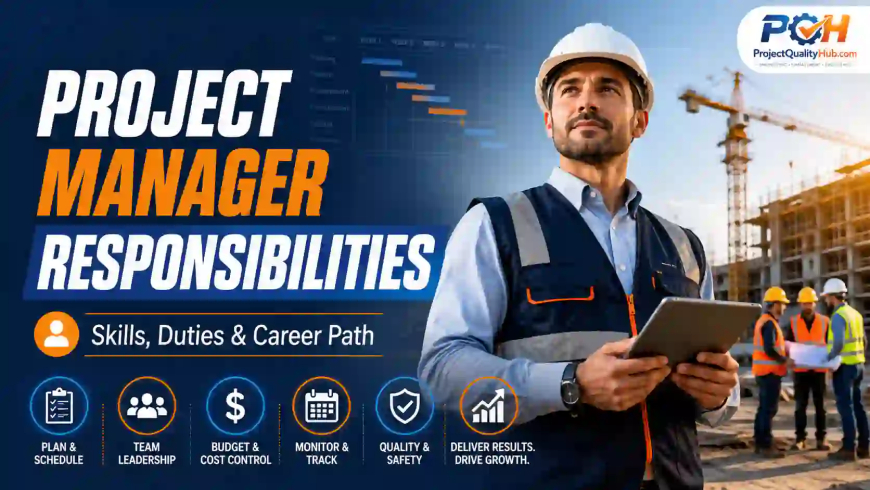
21 Key Responsibilities of a Project Manager: Skills, Career Path & Practical Guide for Beginners
A project manager is responsible for planning, organizing, executing, monitoring, and closing a project successfully. The role includes managing scope, schedule, cost, quality, resources, risks, communication, stakeholders, and team performance. To become a project manager, you need technical knowledge, leadership skills, communication ability, problem-solving mindset, and practical project experience.
Introduction
Many people think a project manager only makes schedules and attends meetings. But in real projects, the role is much deeper.
A project manager is the person who connects the client, team, vendors, contractors, management, and ground reality. When drawings are delayed, materials are not available, manpower is short, cost is increasing, or the client is asking for urgent progress, the project manager has to bring everything under control.
Whether it is a construction project, IT project, manufacturing project, infrastructure work, or industrial installation, the basic responsibility is the same: deliver the project safely, within scope, within budget, and as close as possible to the planned timeline.
In this article, we will understand the responsibilities of a project manager, required skills, practical examples, common mistakes, and the best steps to build a career in project management.
What Is a Project Manager?
A project manager is a professional responsible for leading a project from start to finish. The project manager makes sure that the project objectives are clearly understood, properly planned, executed, monitored, and completed.
In simple words, a project manager converts a plan into actual results.
For example, in a construction project, the project manager ensures that drawings are approved, materials are arranged, contractors are mobilized, work is executed as per quality standards, safety rules are followed, progress is tracked, and client requirements are met.
A project manager does not do every task personally. Instead, he or she coordinates people, processes, tools, and decisions so that the project moves in the right direction.
Why Project Manager Responsibilities Are Important
The responsibilities of a project manager are important because projects usually involve many moving parts.
A small delay in one activity can affect the full project. For example, if foundation work is delayed, equipment erection may be delayed. If equipment erection is delayed, electrical work may be delayed. If electrical work is delayed, testing and commissioning may also be delayed.
This is why a project manager is needed to maintain control.
A good project manager helps in:
- Avoiding confusion between teams
- Reducing delays
- Controlling cost
- Managing risks
- Improving communication
- Maintaining quality
- Handling client expectations
- Solving practical site problems
- Keeping records for future claims or decisions
- Completing the project in a structured manner
Without project management, many projects become dependent on follow-up, pressure, and firefighting. That is not a sustainable way to work.
Main Responsibilities of a Project Manager
The role of a project manager may change from industry to industry, but the core responsibilities remain almost the same.
1. Understanding the Project Scope
The first responsibility of a project manager is to understand what exactly has to be delivered.
Scope includes:
- What work is included
- What work is excluded
- Technical requirements
- Contract conditions
- Deliverables
- Client expectations
- Quality standards
- Completion criteria
For example, in a construction project, scope may include civil work, structural work, mechanical installation, electrical work, testing, commissioning, documentation, and handover.
If scope is not clear, disputes are almost guaranteed. That is why the project manager must study the contract, technical specifications, drawings, bill of quantities, and client requirements carefully.
Practical tip:
Before starting work, prepare a simple scope summary. Share it with the team so everyone understands what is included and what is not.
2. Preparing the Project Plan
Planning is one of the most important project manager responsibilities.
A project plan explains how the project will be executed. It includes schedule, resources, budget, procurement, quality, safety, communication, and risk planning.
A practical project plan should answer:
- What work needs to be done?
- Who will do it?
- When will it be done?
- What materials are required?
- What approvals are needed?
- What risks may affect the work?
- How will progress be measured?
In real projects, planning is not only about preparing a beautiful Gantt chart. Planning means thinking ahead before problems become serious.
3. Creating and Managing the Schedule
The project manager is responsible for developing and monitoring the project schedule.
The schedule shows activity sequence, duration, dependencies, milestones, and critical activities. In construction and industrial projects, tools like Primavera P6, MS Project, or Excel are commonly used.
A good schedule helps the team understand:
- Which activities are urgent
- Which activities are dependent on others
- Which activities are on the critical path
- Where delays are happening
- What recovery actions are required
For example, if equipment delivery is delayed, the project manager must check how it affects erection, alignment, cable laying, testing, and commissioning.
Site reality:
Schedule banana easy hai, but schedule ko ground reality ke according update karna is the real project management work.
4. Managing Project Cost and Budget
A project manager must monitor project cost regularly.
Cost management includes:
- Budget planning
- Cost tracking
- Labor cost control
- Material cost control
- Equipment cost monitoring
- Vendor payment tracking
- Extra work identification
- Cost overrun control
For example, if a project requires additional manpower due to delay, the project manager must understand whether the cost is within budget or due to client-side hindrance.
Cost control is not only the job of the finance department. The project manager must know where money is being spent and why.
5. Managing Resources
Resources include manpower, machinery, materials, tools, subcontractors, vendors, and time.
The project manager has to ensure that the right resources are available at the right time.
For example:
| Resource Type | Project Manager’s Responsibility |
|---|---|
| Manpower | Arrange skilled workers and supervisors |
| Materials | Ensure timely availability at site |
| Machinery | Plan cranes, tools, vehicles, and equipment |
| Vendors | Follow up for supply, installation, and support |
| Documents | Ensure drawings, approvals, and certificates are available |
Poor resource planning can stop even a well-planned project.
6. Managing Communication
Communication is one of the most underrated project management skills.
A project manager communicates with:
- Client
- Consultant
- Internal management
- Site team
- Contractors
- Vendors
- Quality team
- Safety team
- Planning team
- Finance and billing team
Good communication prevents misunderstandings.
For example, if a drawing is pending from the client, the project manager should not wait silently. A formal email, reminder, meeting discussion, and record of delay should be maintained.
Expert tip:
In projects, verbal communication solves today’s problem, but written communication protects tomorrow’s claim.
7. Managing Quality
The project manager must ensure that work is completed as per approved drawings, specifications, standards, and quality plans.
Quality management includes:
- Inspection planning
- Material approval
- Method statement review
- Checklist implementation
- Testing and inspection
- Non-conformance control
- Documentation
- Client inspection coordination
For example, in civil work, concrete quality, reinforcement checking, shuttering, curing, and cube testing must be monitored. In mechanical work, alignment, welding, torque tightening, and testing records may be required.
Quality should not be checked only at the end. It must be built into the execution process.
8. Managing Safety
Safety is a core responsibility of every project manager, especially in construction, manufacturing, EPC, oil and gas, steel plant, and infrastructure projects.
The project manager must ensure:
- Site safety rules are followed
- Work permits are issued
- PPE is used
- Risk assessments are done
- Toolbox talks are conducted
- Unsafe acts are stopped
- Incidents are reported
- Corrective actions are taken
A project completed with accidents cannot be called successful.
Safety is not only the safety officer’s job. The project manager must create a culture where safety is treated as part of execution.
9. Managing Risks
Every project has risks.
Common project risks include:
- Drawing delays
- Material shortage
- Vendor delay
- Labor issues
- Weather problems
- Site access issues
- Design changes
- Cost escalation
- Safety incidents
- Equipment failure
- Approval delays
A project manager should identify risks early and prepare mitigation plans.
For example, if imported equipment has long delivery time, the project manager should track procurement early instead of waiting until the erection stage.
Practical risk workflow:
- Identify possible risk
- Assess impact
- Assign responsibility
- Prepare mitigation plan
- Track regularly
- Escalate if required
10. Managing Stakeholders
Stakeholders are people or organizations affected by the project.
They may include clients, consultants, contractors, vendors, government authorities, internal management, end users, and local teams.
A project manager must understand stakeholder expectations and manage them carefully.
For example, the client may focus on completion date, the consultant may focus on technical compliance, the contractor may focus on payment, and management may focus on cost and cash flow.
The project manager has to balance all these expectations.
11. Monitoring Progress
Progress monitoring is a daily responsibility of a project manager.
It includes:
- Daily progress review
- Weekly progress reports
- Monthly review meetings
- Milestone tracking
- Delay identification
- Productivity analysis
- Site photographs
- Progress measurement sheets
For example, if planned progress was 20% but actual progress is only 12%, the project manager must find the reason. Is it due to manpower shortage, drawing delay, material delay, site obstruction, or poor contractor performance?
Progress tracking should lead to action, not just reporting.
12. Managing Change
Changes are common in projects.
Changes may happen due to:
- Design revision
- Client requirement
- Site condition
- Technical correction
- Additional scope
- Material change
- Safety requirement
- Statutory compliance
The project manager must ensure that changes are documented, approved, and evaluated for time and cost impact.
A common mistake is executing extra work without written approval. Later, it becomes difficult to claim payment or extension.
13. Managing Contractors and Vendors
In many projects, contractors and vendors play a major role.
The project manager must coordinate with them for:
- Mobilization
- Work progress
- Quality compliance
- Safety compliance
- Document submission
- Billing
- Delay recovery
- Issue resolution
For example, if a vendor is required for equipment commissioning, the project manager must confirm readiness of foundation, power supply, utilities, tools, manpower, and client availability before calling the vendor.
Otherwise, the visit may fail and additional cost may occur.
14. Reporting to Management and Client
Project reporting is another major responsibility.
Reports may include:
- Daily progress report
- Weekly progress report
- Monthly progress report
- Cost report
- Risk report
- Delay report
- Procurement status
- Billing status
- Safety report
- Quality report
A good report should be clear, factual, and action-oriented.
Avoid writing only “work in progress.” Instead, mention what was done, what is pending, what support is required, and what risk exists.
15. Closing the Project
Project closure is often ignored, but it is very important.
Closure includes:
- Final inspection
- Testing and commissioning
- Punch point clearance
- Documentation
- As-built drawings
- Completion certificate
- Billing closure
- Warranty documents
- Handover
- Lessons learned
A project is not truly complete until documentation, commercial closure, and handover are properly done.
Project Manager Responsibilities Checklist
Use this checklist to understand the role practically:
| Area | Responsibility |
| Scope | Understand and control project deliverables |
| Schedule | Prepare, update, and monitor timeline |
| Cost | Track budget and control expenses |
| Quality | Ensure work meets specifications |
| Safety | Maintain safe working conditions |
| Resources | Arrange manpower, materials, tools, and vendors |
| Communication | Coordinate with all stakeholders |
| Risk | Identify and reduce project risks |
| Procurement | Follow up for material and vendor supplies |
| Documentation | Maintain records, reports, and approvals |
| Change Control | Track variations and extra work |
| Closure | Complete handover and final documentation |
Skills Required for a Project Manager
A project manager needs both technical and soft skills. Only technical knowledge is not enough, and only communication skills are also not enough.
Key Skills Required
| Skill | Why It Matters |
| Leadership | To guide the team and take ownership |
| Communication | To avoid confusion and delays |
| Planning | To organize work before execution |
| Problem-solving | To handle site and project issues |
| Technical knowledge | To understand work requirements |
| Cost awareness | To control budget and avoid losses |
| Risk management | To reduce surprises |
| Negotiation | To deal with clients, vendors, and contractors |
| Decision-making | To act quickly when problems arise |
| Documentation | To maintain records and support claims |
Technical Skills vs Soft Skills
Both technical skills and soft skills are necessary.
| Technical Skills | Soft Skills |
| Scheduling | Leadership |
| Cost control | Communication |
| Quality management | Team handling |
| Contract understanding | Conflict resolution |
| Risk analysis | Negotiation |
| Software tools | Decision-making |
| Documentation | Emotional control |
For example, a project manager may know Primavera P6 very well, but if he cannot communicate delay issues clearly to the client, the project may still suffer.
Similarly, a person may be good at communication but without technical understanding, he may miss important execution risks.
Real Industry Case Study: How Small Delays Become Big Problems
In one industrial project, the equipment foundation was completed, but the approved electrical drawing was delayed. The equipment arrived at site, but installation could not start because power supply routing was not finalized.
At first, it looked like a small documentation issue. But later it affected equipment placement, cable tray work, vendor commissioning visit, and client inspection.
A practical project manager would handle this by:
- Tracking drawing approval early
- Highlighting the issue in weekly meetings
- Sending written reminders
- Updating the risk register
- Checking alternative work fronts
- Avoiding unnecessary vendor mobilization
- Maintaining delay records
This is why proactive project management is important. Many project delays do not happen suddenly. They grow silently because early warning signs are ignored.
Advantages of Having a Good Project Manager
A good project manager adds direct value to the organization.
Benefits include:
- Better planning
- Faster decision-making
- Reduced delays
- Better team coordination
- Improved client satisfaction
- Lower cost overrun
- Better quality control
- Stronger documentation
- Better risk handling
- Clear accountability
Good project managers do not only manage work. They create confidence among clients, teams, and management.
Limitations of a Project Manager Role
A project manager is important, but not a magician.
There are limitations.
A project manager cannot fully control:
- Extreme weather
- Sudden policy changes
- Unreasonable client delays
- Global supply chain issues
- Poorly defined contract scope
- Financial crisis
- Major design changes
- Lack of organizational support
However, a good project manager can reduce the impact by planning early, communicating clearly, and documenting properly.
Common Mistakes New Project Managers Make
Many new project managers make avoidable mistakes.
Common mistakes include:
- Starting work without clear scope
- Depending only on verbal instructions
- Not maintaining written records
- Ignoring early warning signs
- Poor follow-up with vendors
- Not updating project schedule
- Not tracking cost
- Avoiding difficult conversations
- Not escalating issues on time
- Focusing only on reporting, not action
- Ignoring safety and quality pressure
- Saying yes to every client demand without checking impact
Expert Tips for Future Project Managers
Here are some practical tips from real project environments:
- Always understand the contract before execution.
Many disputes start because the team does not know the scope clearly. - Maintain written communication.
Emails, MOMs, reports, and approvals protect the project. - Visit the site regularly.
Reports are useful, but ground reality gives the real picture. - Track critical activities closely.
Not all activities have the same impact. Focus on the critical path. - Build relationships, not just pressure.
Contractors, vendors, and clients respond better when communication is professional. - Do not hide problems.
Early escalation is better than late surprise. - Learn from every project.
Every delay, dispute, and mistake is a practical lesson.
Conclusion
The responsibilities of a project manager are much more than preparing schedules or attending review meetings. A project manager is the central person who keeps the project moving in the right direction.
If you want to build a career in project management, start by learning the basics of scope, planning, cost, quality, safety, communication, and risk. Then gain practical experience, handle small responsibilities, learn project management tools, and improve your leadership skills.
A good project manager is not the person who never faces problems. A good project manager is the person who identifies problems early, communicates clearly, takes action, and leads the team toward project completion.
FAQs About Project Manager Responsibilities
1. What are the main responsibilities of a project manager?
The main responsibilities of a project manager include planning, scheduling, cost control, quality management, safety coordination, resource management, risk handling, communication, stakeholder management, progress monitoring, and project closure.
2. What skills are required to become a project manager?
A project manager needs leadership, communication, planning, problem-solving, technical understanding, cost awareness, risk management, negotiation, decision-making, and documentation skills.
3. Is technical knowledge necessary for a project manager?
Yes, technical knowledge is important, especially in construction, engineering, IT, manufacturing, and industrial projects. A project manager does not need to be the deepest technical expert, but must understand enough to make practical decisions.
4. Can a fresher become a project manager?
Usually, freshers start as project coordinators, site engineers, planning engineers, or team members. With practical experience and responsibility, they can grow into project manager roles.
5. What is the difference between a project manager and a project coordinator?
A project coordinator usually supports documentation, follow-up, reporting, and coordination. A project manager has higher responsibility for planning, execution, decisions, cost, risk, team performance, and project delivery.
6. Which software should a project manager learn?
Useful software includes Excel, MS Project, Primavera P6, Power BI, ERP tools, document control software, and collaboration platforms. The best tool depends on the industry and project size.
7. Is PMP certification required to become a project manager?
PMP certification is not always required, but it can help in career growth, especially for experienced professionals. Practical experience is still very important.
8. What does a project manager do daily?
A project manager reviews progress, coordinates with teams, solves issues, attends meetings, follows up with vendors, checks risks, updates schedules, communicates with clients, and ensures planned work is moving properly.
9. What makes a good project manager?
A good project manager is proactive, organized, practical, clear in communication, strong in follow-up, calm under pressure, and capable of taking timely decisions.
10. Is project management a good career?
Yes, project management is a strong career path because almost every industry needs professionals who can deliver work on time, within budget, and with proper quality.
Related Articles
- Lean Six Sigma White Belt: Beginner Guide
- Six Sigma DMAIC Model Explained in Simple words
- SIPOC Diagram in Six Sigma Explained Simply
- Check Sheet in Six Sigma Explained with Examples
- Histogram in Six Sigma: Simple Tool, Powerful Insights
- Pareto Chart in Six Sigma: Fix 80% Problems Fast
- 5 Why Analysis in Six Sigma (Simple Practical Guide)