Download Quality Assurance Plan for Construction Project: Complete Editable Word Format for Engineers
Download Quality Assurance Plan for Construction Project: Complete Editable Word Format for Engineers
 Suraj Manikpuri
Introduction
Preparing a construction quality document from zero is not easy.
You need a quality policy, organization chart, roles and responsibilities, material control procedure, inspection system, testing requirements, NCR process, audit procedure, and handover records.
For many engineers, the biggest problem is not understanding quality. The real problem is preparing a properly formatted document that can be submitted to a client, consultant, or project management team.
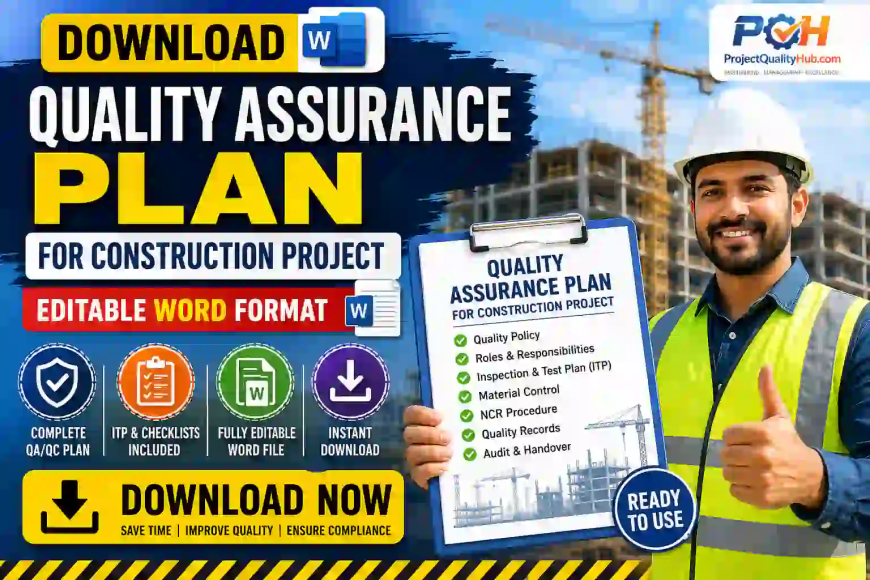
That is why this article provides a practical Quality Assurance Plan for Construction Project in editable Word format.
You can use it as a base document and modify it as per your project specifications, contract requirements, client format, and applicable standards.
What Is a Quality Assurance Plan for a Construction Project?
A Quality Assurance Plan, also called a QA Plan, QA/QC Plan, or Project Quality Plan, is a formal document that explains how construction quality will be achieved and controlled throughout the project.
It defines:
- What quality standards will be followed
- Who is responsible for quality
- How materials will be approved and inspected
- Which tests are required
- How work inspections will be carried out
- How non-conformities will be handled
- What records must be maintained
- How final quality documents will be submitted
In simple words, it is a roadmap for maintaining quality from project start to handover.
Download Quality Assurance Plan for Construction Project in Word Format
You can download the editable Word file here:
Download here: Quality Assurance Plan for Construction Projec

This document is prepared in a professional format so engineers, QA/QC teams, site teams, and project managers can use it directly after project-specific customization.
What Is Included in This Quality Assurance Plan?
The downloadable Word document includes the major sections generally required in a construction project quality plan.
Main Contents Included
| Section | Purpose |
|---|---|
| Cover Page | Project name, document title, revision details |
| Document Control | Revision history and approval tracking |
| Quality Policy | Project quality commitment |
| Scope of Work | Activities covered under the QA plan |
| Standards and References | Applicable codes, specifications, and drawings |
| Organization Chart | Quality responsibility structure |
| Roles and Responsibilities | Duties of project and quality team |
| Material Control Procedure | Material approval, receipt, storage, and inspection |
| Method Statement Control | Activity-wise execution methodology |
| Inspection and Test Plan | Stage-wise inspection and testing requirement |
| NCR Procedure | Handling of non-conforming work |
| Corrective Action System | Root cause and prevention process |
| Quality Records | Documentation and traceability |
| Audit Procedure | Internal quality audit and review |
| Handover Requirements | Final quality dossier submission |
Why Do Construction Projects Need a QA Plan?
Construction work involves many activities, materials, agencies, and approvals. Without a proper quality assurance system, defects can happen at any stage.
A QA plan helps to:
- Avoid rework
- Reduce rejection from client or consultant
- Improve workmanship
- Control material quality
- Maintain inspection records
- Ensure compliance with approved drawings
- Reduce disputes during billing and handover
- Improve project reliability and durability
For example, if reinforcement is fixed incorrectly and checked only after concreting, correction becomes very difficult. But if the QA plan defines inspection hold points before concrete pouring, the mistake can be identified and corrected before it becomes costly.
That is the actual value of quality assurance.
Difference Between QA Plan and QC Plan
Many beginners get confused between QA and QC.
Both are related, but they are not the same.
| Point | Quality Assurance Plan | Quality Control Plan |
| Focus | Process and prevention | Inspection and testing |
| Timing | Before and during work | During and after work |
| Purpose | Avoid defects | Identify defects |
| Example | Method statement, ITP, audit | Cube test, alignment check, DFT check |
| Nature | System-based | Result-based |
In practical construction language:
QA means planning quality before mistakes happen.
QC means checking whether completed work is acceptable or not.
A good construction project needs both.
Who Can Use This QA Plan Template?
This Word format quality assurance plan can be useful for:
- QA/QC Engineers
- Civil Engineers
- Site Engineers
- Project Engineers
- Construction Managers
- Planning Engineers
- Project Managers
- Contractors
- Subcontractors
- Consultants
- Students and beginners learning construction quality management
It can be used for different types of projects, including:
- Building construction
- Industrial construction
- Civil infrastructure projects
- Steel plant projects
- Road and bridge projects
- Foundation works
- Structural works
- Mechanical and electrical construction works
- Residential and commercial projects
Key Sections Explained
1. Project Quality Policy
The quality policy defines the project team’s commitment to complete the work as per approved drawings, technical specifications, codes, and contractual requirements.
It sets the overall quality direction for the project.
2. Scope of Work
This section explains which project activities are covered under the quality assurance plan.
For example:
- Earthwork
- PCC
- RCC
- Structural steel
- Masonry
- Plastering
- Waterproofing
- Flooring
- Painting
- MEP works
- Final finishing
You should modify this section as per your actual project scope.
3. Roles and Responsibilities
A QA plan must clearly define who is responsible for quality.
Typical responsibilities include:
- Project Manager: Overall implementation of quality system
- QA/QC Manager: Preparation and monitoring of QA/QC procedures
- QA/QC Engineer: Inspection, testing, documentation, and NCR follow-up
- Site Engineer: Execution as per approved drawings and method statement
- Store In-charge: Material receipt, storage, and issue control
- Subcontractor: Compliance with approved procedures and quality requirements
Clear responsibility avoids confusion at site.
4. Material Control Procedure
Material quality is one of the most important parts of construction quality.
This section explains how materials will be:
- Submitted for approval
- Received at site
- Inspected before use
- Stored properly
- Rejected if found unsuitable
- Tracked through records
Examples of material quality documents:
- Material Approval Request
- Manufacturer Test Certificate
- Third-Party Test Report
- Material Inspection Report
- Delivery Challan
- Storage Inspection Checklist
5. Inspection and Test Plan
The Inspection and Test Plan, or ITP, is the heart of a construction QA/QC system.
It defines:
- Activity stages
- Type of inspection
- Testing requirement
- Acceptance criteria
- Inspection frequency
- Responsible person
- Hold points and witness points
- Required records
Example:
Before concreting, reinforcement, shuttering, cover blocks, embedment, anchor bolts, and cleanliness should be checked and approved.
6. Non-Conformance Report Procedure
NCR means Non-Conformance Report.
It is raised when work, material, or procedure does not comply with approved requirements.
Common NCR examples:
- Wrong reinforcement spacing
- Honeycombing in concrete
- Use of unapproved material
- Poor welding quality
- Incorrect level or alignment
- Missing test records
- Work executed without inspection approval
A good QA plan defines how NCRs will be raised, reviewed, corrected, approved, and closed.
Practical Example: How This QA Plan Helps on Site
Suppose concrete pouring is planned for a foundation.
Without a QA plan, the site team may directly call the client for inspection or start pouring in a hurry.
But with a proper QA plan, the workflow becomes clear:
- Site engineer completes internal checking.
- QA/QC engineer verifies reinforcement, shuttering, and embedded items.
- Pour card is prepared.
- Slump test requirement is confirmed.
- Cube sample requirement is confirmed.
- Client inspection request is submitted.
- Approval is received.
- Concrete pouring starts.
- Test records are maintained.
- Curing record is updated.
This simple system prevents mistakes and creates proper traceability.
Editable Word Format: Why It Is Useful
A Word file is useful because you can easily customize it.
You can edit:
- Project name
- Client name
- Contractor name
- Revision number
- Scope of work
- Applicable standards
- Organization chart
- Inspection stages
- Testing frequency
- Approval matrix
- Checklists
- Formats
- Handover requirements
This saves time compared to preparing the complete document from blank.
How to Customize the QA Plan for Your Project
After downloading the file, follow this practical customization process:
Step 1: Add Project Details
Update the cover page with:
- Project name
- Client name
- Contractor name
- Consultant name
- Document number
- Revision number
- Date of issue
Step 2: Review Contract Requirements
Check your contract specifications and add project-specific quality requirements.
Do not submit the document without matching it with your project specification.
Step 3: Update Scope of Work
Remove activities that are not applicable and add missing activities.
For example, if your project includes waterproofing, piling, road work, or structural steel, include those activities properly.
Step 4: Update Codes and Standards
Add applicable national, international, and client-specific standards.
Step 5: Modify ITP
Update inspection stages, acceptance criteria, hold points, witness points, and records.
Step 6: Add Project-Specific Formats
Attach or refer to your approved formats, such as:
- Work Inspection Request
- Material Inspection Report
- NCR Format
- Concrete Pour Card
- Cube Test Register
- Calibration Register
- Final Handover Checklist
Step 7: Submit for Approval
After internal review, submit the QA plan to the client or consultant for approval.
Common Mistakes While Preparing a QA Plan
Avoid these common mistakes:
- Copying another project’s QA plan without modification
- Not matching the plan with contract specifications
- Missing ITPs for critical activities
- Not defining responsibilities clearly
- Using outdated codes and standards
- Not including NCR procedure
- Not defining quality records
- Not training site engineers and supervisors
- Treating QA plan only as a submission document
A QA plan is useful only when the site team follows it practically.
Quality Assurance Plan Checklist Before Submission
Before submitting your QA plan, check the following:
- Project details are correct
- Revision number is updated
- Scope of work matches the project
- Applicable standards are listed
- Organization chart is included
- Roles and responsibilities are clear
- Material approval process is defined
- Method statement control is included
- Inspection and Test Plan is attached
- NCR procedure is included
- Quality record list is included
- Audit procedure is included
- Handover document list is included
- Approval page is properly formatted
Benefits of Downloading This QA Plan Template
This document helps you:
- Save preparation time
- Understand professional QA plan structure
- Prepare client submission faster
- Improve site quality documentation
- Train junior engineers
- Standardize quality workflow
- Reduce missing sections
- Improve project quality control
For students and beginners, this template also works as a learning reference for understanding how real construction quality documents are prepared.
Limitations of a Ready-Made QA Plan Template
A ready-made template is helpful, but it should not be submitted blindly.
You must customize it because every project has different:
- Contract conditions
- Client requirements
- Technical specifications
- Inspection stages
- Testing frequency
- Codes and standards
- Approval workflow
- Documentation format
Use this document as a strong base, then modify it professionally.
Final Thoughts
A Quality Assurance Plan for Construction Project is one of the most important documents for project quality management.
It gives a clear system for material approval, inspection, testing, documentation, NCR handling, audit, and final handover.
The downloadable Word file is prepared to help engineers, contractors, QA/QC professionals, and project teams save time and create a structured quality document for construction projects.
Download the file, customize it as per your project, and use it as a practical working document — not only as a formality for approval.
Download here: Quality Assurance Plan for Construction Projec
FAQs
1. What is a Quality Assurance Plan for Construction Project?
A Quality Assurance Plan for Construction Project is a document that defines how quality will be planned, controlled, inspected, tested, recorded, and improved during construction work.
2. Can I download this QA plan in Word format?
Yes. The QA plan is available in editable Word format so you can modify it as per your project requirements.
3. Who prepares the QA plan in construction?
Usually, the QA/QC Manager or QA/QC Engineer prepares the QA plan with input from the Project Manager, Construction Manager, Site Engineers, and planning team.
4. Is this QA plan useful for civil construction work?
Yes. It can be customized for civil works such as excavation, PCC, RCC, reinforcement, shuttering, masonry, plastering, waterproofing, flooring, and finishing works.
5. What is the difference between QA Plan and ITP?
A QA Plan is the overall quality management document for the project. An ITP, or Inspection and Test Plan, is a specific document that defines inspection and testing requirements for each activity.
6. Is this QA plan suitable for contractors?
Yes. Contractors can use it as a base document for client submission after modifying it according to project specifications and contract requirements.
7. Can students use this QA plan?
Yes. Students and beginners can use this document to understand how construction quality assurance is planned and documented in real projects.
8. What records are included in a construction QA plan?
Common records include material inspection reports, work inspection requests, test reports, calibration records, NCRs, corrective action reports, audit reports, and final handover documents.
9. Should I submit the template directly to the client?
No. You should first customize it with project-specific details, applicable standards, client requirements, and inspection/test requirements before submission.
10. Why is a QA plan important in construction?
A QA plan is important because it helps prevent defects, reduce rework, improve documentation, ensure specification compliance, and support smooth project handover.