ISO 9001 Explained: Complete QMS Guide for Beginners (2026)
Learn what ISO 9001 is, how it relates to Quality Management Systems (QMS), its benefits, implementation process, real-world examples, FAQs, and expert tips.
 Suraj Manikpuri
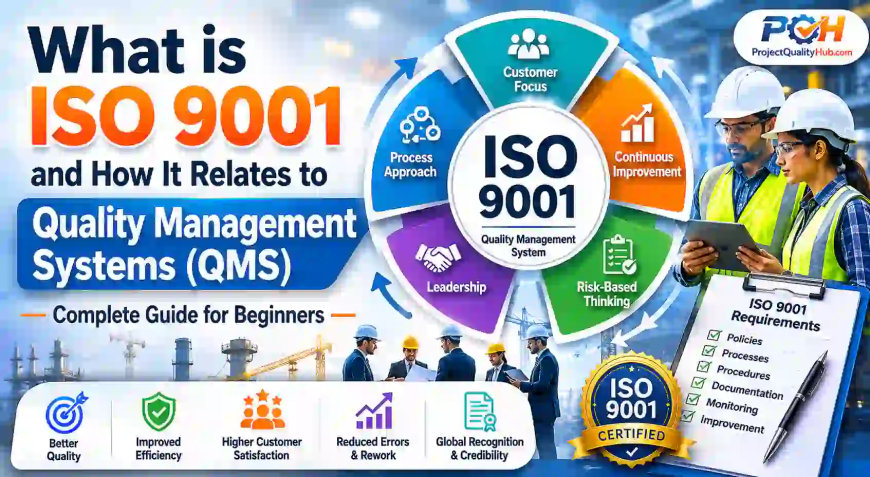
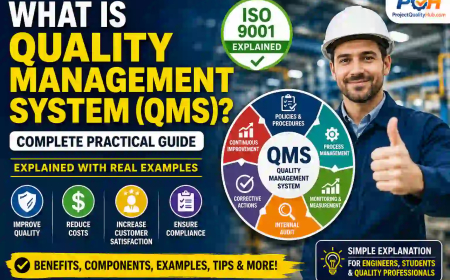
ISO 9001 is the world's most widely recognized standard for Quality Management Systems (QMS). It provides a framework that helps organizations consistently deliver products and services that meet customer and regulatory requirements while continuously improving processes, quality, and customer satisfaction.
Introduction
Have you ever wondered why some companies consistently deliver high-quality products while others struggle with customer complaints, rework, and delays?
In many cases, the difference lies in their Quality Management System (QMS).
One of the most trusted frameworks for building an effective QMS is ISO 9001. Whether you work in manufacturing, construction, software development, healthcare, education, or project management, ISO 9001 provides a structured approach to managing quality.
Many people assume ISO 9001 is just a certificate to hang on the office wall. In reality, organizations that properly implement ISO 9001 often see improvements in efficiency, customer satisfaction, process control, and profitability.
In this guide, you'll learn:
- What ISO 9001 is
- How it relates to Quality Management Systems
- Key requirements
- Practical implementation steps
- Real-world examples
- Common mistakes to avoid
- Expert tips from industry experience
What is ISO 9001?
ISO 9001 is an international standard published by the International Organization for Standardization (ISO).
It specifies requirements for establishing, implementing, maintaining, and continually improving a Quality Management System (QMS).
The latest version is:
ISO 9001:2015
The standard is designed for organizations of all sizes and industries.
From a small machine shop to a multinational corporation, ISO 9001 can be applied effectively.
What is a Quality Management System (QMS)?
A Quality Management System is a structured set of policies, procedures, processes, and records used to ensure consistent quality.
Think of QMS as the operating system of an organization.
A good QMS helps answer:
- How work should be performed
- Who is responsible
- What quality standards apply
- How performance is measured
- How improvements are implemented
Without a QMS, organizations often rely on individual experience rather than standardized processes.
How ISO 9001 Relates to Quality Management Systems
Many people confuse ISO 9001 and QMS.
The relationship is simple:
| Term | Meaning |
|---|---|
| QMS | The actual management system used to control quality |
| ISO 9001 | The international standard that defines QMS requirements |
In simple words:
A QMS is the system. ISO 9001 is the blueprint.
ISO 9001 provides the structure needed to build an effective quality management framework.
The 7 Quality Management Principles Behind ISO 9001
ISO 9001 is built on seven core principles.
1. Customer Focus
Understanding customer needs and exceeding expectations.
2. Leadership
Management creates direction and quality culture.
3. Engagement of People
Employees contribute to organizational success.
4. Process Approach
Managing activities as interconnected processes.
5. Improvement
Continuous improvement remains a permanent objective.
6. Evidence-Based Decision Making
Using data instead of assumptions.
7. Relationship Management
Managing suppliers and stakeholders effectively.
Key Requirements of ISO 9001
The standard contains several important clauses.
| Clause | Purpose |
|---|---|
| Context of Organization | Understanding internal and external issues |
| Leadership | Commitment from top management |
| Planning | Risk and opportunity management |
| Support | Resources and competence |
| Operation | Process control |
| Performance Evaluation | Monitoring and measurement |
| Improvement | Corrective actions and continual improvement |
These clauses work together to create a comprehensive QMS.
Step-by-Step ISO 9001 Implementation Process
Organizations often ask:
"How do we implement ISO 9001?"
Follow these practical steps:
Step 1: Understand Requirements
Study ISO 9001 requirements thoroughly.
Step 2: Conduct Gap Analysis
Compare current practices against ISO requirements.
Step 3: Define Processes
Document key operational processes.
Step 4: Establish Quality Objectives
Set measurable quality goals.
Step 5: Train Employees
Build awareness across the organization.
Step 6: Implement Processes
Put procedures into daily practice.
Step 7: Conduct Internal Audits
Verify compliance and effectiveness.
Step 8: Management Review
Evaluate system performance.
Step 9: Certification Audit
Invite an accredited certification body.
Step 10: Continual Improvement
Keep improving after certification.
Practical Example: ISO 9001 in a Manufacturing Plant
A steel fabrication company faced:
- High rework rates
- Delivery delays
- Customer complaints
After implementing ISO 9001:
Actions Taken
- Standardized inspection procedures
- Introduced calibration controls
- Defined responsibilities
- Improved supplier evaluation
Results
- 30% reduction in rework
- Improved on-time delivery
- Increased customer satisfaction
- Better audit performance
This demonstrates how ISO 9001 delivers real operational benefits.
ISO 9001 in Construction Projects
In construction, ISO 9001 helps manage:
- Material inspections
- Contractor quality control
- Site documentation
- Non-conformance management
- Client requirements
- Inspection and Test Plans (ITPs)
For project managers, ISO 9001 provides a structured approach to controlling quality throughout project execution.
Real Industry Case Study
Problem
A medium-sized engineering company experienced recurring customer complaints about dimensional inaccuracies.
Root Cause
No standardized inspection process existed.
Different inspectors used different methods.
Solution
The company implemented ISO 9001 requirements by:
- Standardizing inspection procedures
- Training inspectors
- Implementing calibration programs
- Creating corrective action workflows
Outcome
Within one year:
- Complaints reduced by 45%
- Rework reduced by 28%
- Customer retention improved significantly
Advantages and Disadvantages of ISO 9001
| Advantages | Disadvantages |
|---|---|
| Improved customer satisfaction | Initial implementation effort |
| Better process control | Training costs |
| Reduced errors | Documentation requirements |
| Enhanced credibility | Audit preparation time |
| Increased efficiency | Resistance to change |
| Better risk management | Ongoing maintenance |
Overall, the benefits generally outweigh the challenges.
Common ISO 9001 Implementation Mistakes
Many organizations fail because they focus only on certification.
Common mistakes include:
Documentation Overload
Creating excessive paperwork.
Lack of Leadership Support
Management not actively participating.
Employee Resistance
Insufficient awareness and training.
Ignoring Process Performance
Focusing on documents instead of results.
Treating Audits as Formalities
Missing opportunities for improvement.
ISO 9001 Myths vs Facts
| Myth | Fact |
|---|---|
| ISO 9001 is only for manufacturing | Applicable to all industries |
| Certification guarantees quality | Effective implementation creates quality |
| Only large companies need ISO 9001 | Small businesses benefit too |
| ISO means excessive paperwork | Modern ISO focuses on effectiveness |
| Certification is the final goal | Continuous improvement is the goal |
Expert Tips for Successful ISO 9001 Implementation
From practical project and industrial experience:
Keep Documentation Simple
Only document what adds value.
Focus on Processes
Quality comes from process control.
Use Data
Track KPIs and performance metrics.
Engage Employees
Quality is everyone's responsibility.
Make Audits Meaningful
Use audits to improve operations.
Think Long-Term
ISO 9001 should become part of company culture.
Key Takeaways
✅ ISO 9001 is the world's leading Quality Management System standard.
✅ A QMS helps organizations consistently meet customer requirements.
✅ ISO 9001 provides the framework for building an effective QMS.
✅ Certification alone is not enough; practical implementation matters.
✅ Benefits include improved quality, reduced costs, higher customer satisfaction, and continual improvement.
✅ ISO 9001 can be applied in manufacturing, construction, healthcare, education, software, and service industries.
ISO 9001 is much more than a certification standard—it is a practical framework for building a strong Quality Management System. Organizations that genuinely implement ISO 9001 often achieve better process control, improved customer satisfaction, reduced waste, and sustainable growth.
Whether you're a student learning about quality management, an engineer managing projects, or a quality professional preparing for certification, understanding how ISO 9001 relates to a Quality Management System is essential for long-term success. The real value comes not from the certificate itself but from the culture of continuous improvement that ISO 9001 encourages.
Frequently Asked Questions (FAQs)
What is ISO 9001 in simple terms?
ISO 9001 is an international standard that provides requirements for establishing and maintaining a Quality Management System.
What is the purpose of ISO 9001?
Its purpose is to improve quality, customer satisfaction, and process effectiveness.
Is ISO 9001 mandatory?
No. It is voluntary unless required by customers, contracts, or regulations.
Who can use ISO 9001?
Organizations of any size and industry can implement ISO 9001.
What are the main principles of ISO 9001?
Customer focus, leadership, engagement of people, process approach, improvement, evidence-based decisions, and relationship management.
How long does ISO 9001 certification take?
Typically 3–12 months depending on company size and readiness.
Does ISO 9001 improve profitability?
Indirectly yes. Better quality reduces waste, rework, and customer complaints.
What is the latest version of ISO 9001?
ISO 9001:2015.
What is the difference between ISO 9001 and quality assurance?
Quality assurance is a function within quality management, while ISO 9001 provides the entire management framework.
Can small businesses benefit from ISO 9001?
Absolutely. Many small businesses use ISO 9001 to improve consistency and credibility.