ASTM B117 Test Guide: Salt Spray Explained
Complete ASTM B117 test guide with steps, examples, and tips. Learn salt spray testing in simple Hinglish for engineers and students.
 Suraj Manikpuri
🧠 A Small Test That Saves Big Problems
During one project, we installed coated steel structures after proper inspection. Everything looked perfect.
But after a few months, rust spots started appearing 😳
Client ne seedha poocha:
👉 “ASTM B117 test kiya tha?”
That moment made it clear—ASTM B117 test is not just a lab activity, it directly affects real project life.
Simple line:
👉 “If you don’t test corrosion properly, future problems are guaranteed.”
🔍 What is ASTM B117 Test?
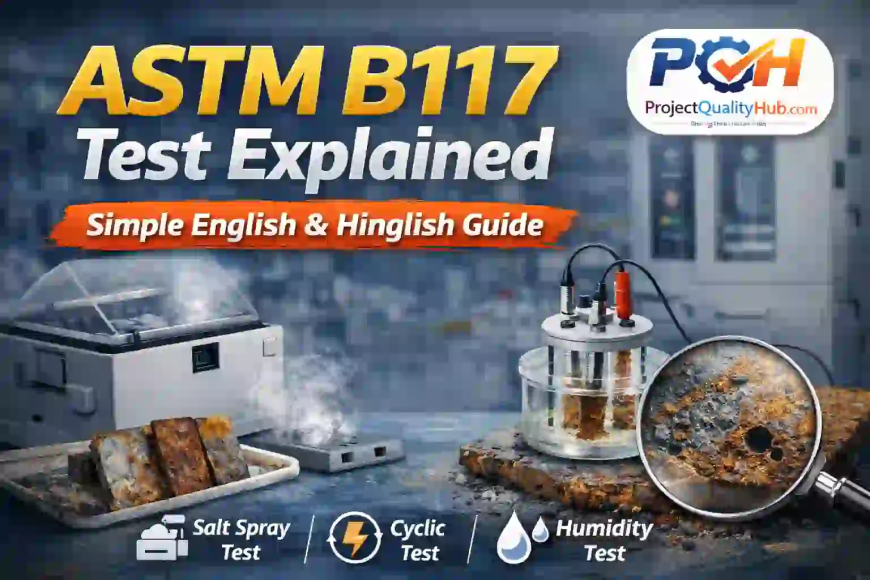
ASTM B117 test is a standard method used to check how materials resist corrosion using a salt spray (fog) environment.
In simple terms:
👉 “Lab ke andar salty environment create karke material ko test kiya jata hai.”
It is widely used for:
- Coatings
- Metals
- Automotive parts
- Industrial equipment

⚙️ Basic Working Principle (Easy Understanding)
- A salt solution (usually 5% NaCl) is sprayed
- Temperature is maintained around 35°C
- Continuous fog is created inside the chamber
- Material is observed over time
👉 “Corrosion process ko fast-forward kar dete hain.”
🧪 Equipment Used in ASTM B117 Test
1. Salt Spray Chamber
Main equipment where testing happens
👉 Controlled temperature + fog environment
2. Air Compressor
Used to generate fine salt mist
3. Solution Tank
Stores salt solution
4. Sample Holder
Holds samples at a fixed angle
🛠️ Step-by-Step ASTM B117 Test Procedure
Step 1: Sample Preparation
- Clean the surface (remove oil, dust)
- Coating should be properly cured
👉 “Wrong preparation = wrong result”
Step 2: Prepare Salt Solution
- 5% NaCl solution
- Maintain pH between 6.5–7.2
Step 3: Set the Chamber
- Temperature: 35°C
- Start salt fog
Step 4: Place the Sample
- Keep at 15–30° angle
Step 5: Run the Test
- Duration: 24, 48, 96, 240, 500+ hours
Step 6: Inspect Results
Check for:
- Rust formation
- Blistering
- Coating damage
👉 “Test ke beech sample ko disturb mat karo.”
🏭 Practical Example (Real Experience)
In one steel project, we tested two coatings:
- Epoxy Coating → Failed at 120 hours
- PU Coating → Passed 500 hours
👉 Final decision: PU coating selected
Result:
✔ Better durability
✔ Less maintenance
✔ Long-term saving
👉 “Right testing = right decision”
📊 How to Understand Results?
ASTM B117 does not directly say pass or fail.
You need to evaluate based on:
- Rust percentage
- Blister size
- Coating failure
👉 “Engineer ko judgement lena padta hai.”
✅ Advantages of ASTM B117 Test
✔ Fast corrosion testing
✔ Easy to perform
✔ Widely accepted standard
✔ Good for comparing coatings
✔ Useful for quality control
❌ Disadvantages / Limitations
✖ Does not fully match real environment
✖ Continuous salt exposure is not always realistic
✖ Not suitable for all materials
✖ Can give misleading results if used alone
👉 “Lab result ≠ real life always”
⚠️ Common Mistakes
❌ Depending only on ASTM B117
❌ Improper cleaning of samples
❌ Wrong test duration
❌ Ignoring coating thickness
👉 “Testing galat, toh decision galat.”
🤯 Common Myths
❌ “500 hours means 5 years life”
✔ No direct relation
❌ “Salt spray test is enough”
✔ Needs other tests also
💡 Expert Tips (Practical Advice)
✔ Use ASTM B117 along with CCT (cyclic test)
✔ Follow proper evaluation standards
✔ Keep equipment calibrated
✔ Record all observations carefully
✔ Choose test based on actual environment
👉 “Smart testing leads to smart engineering.”
🔚 Conclusion: ASTM B117 Test – Use It Wisely
ASTM B117 test is a very useful tool—but only when used correctly.
Don’t just look at hours.
Understand the application, environment, and results.
Final takeaway:
👉 “Test ko samajh ke use karo, tabhi correct decision milega.”
❓ FAQs
1. What is ASTM B117 test?
It is a salt spray corrosion test used to check material resistance.
2. How long does ASTM B117 test take?
It can range from 24 hours to 1000+ hours.
3. Is ASTM B117 test reliable?
Yes, but it should not be used alone.
4. What solution is used in ASTM B117?
Usually 5% NaCl (salt solution).
5. What is the difference between ASTM B117 and CCT?
ASTM B117 is continuous, CCT uses cycles.
6. Is ASTM B117 mandatory?
It depends on project and industry standards.
*Document credit: https://www.galvanizeit.com
Related Articles
- Sample Management Formats for Labs (Complete Guide)
- Quality Management Terminology Made Simple (A Practical Guide for Engineers & Students)
- Complete List of IS Standards for Sample Preparation Equipment in Industrial Research & QC Labs
- Download Sample Receipt Register as per IS Standard (Free + Audit Ready)
- Corrosion Testing Equipment Guide for Labs