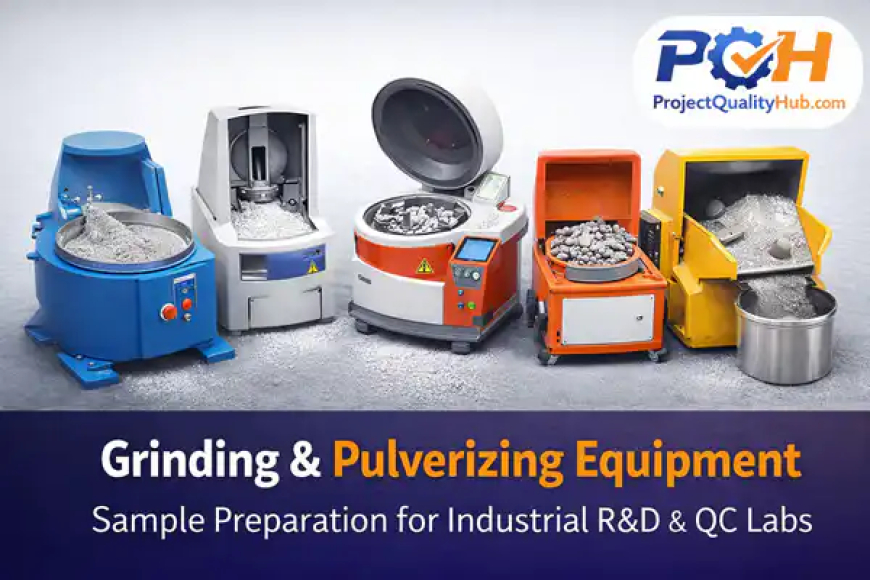
Grinding & Pulverizing Equipment for Industrial Labs
Learn how grinding & pulverizing equipment ensures accurate sample preparation in industrial R&D and QC labs with practical examples and expert tips.
 Suraj Manikpuri
Introduction: Why Grinding and Pulverizing Are Critical in Laboratory Testing
If you’ve ever visited a material testing lab, mining lab, cement plant laboratory, or steel plant R&D center, you’ll notice something interesting.
Before any chemical or physical analysis happens, samples go through a very important step — Grinding & Pulverizing.
Let me explain with a simple example.
Suppose you want to analyze the chemical composition of iron ore, coal, limestone, or cement clinker. These materials usually arrive in the lab as large lumps or coarse particles.
But analytical instruments like:
-
XRF
-
Spectrometers
-
Chemical titration systems
require very fine and uniform powder samples.
This is exactly where Grinding & Pulverizing Equipment becomes essential.
Without proper grinding, the sample will not represent the true composition of the material — and your lab results may become unreliable.
Simply put:
Accurate testing always starts with proper sample preparation.
What is Grinding & Pulverizing Equipment?
Grinding and pulverizing equipment are laboratory machines used to reduce materials into fine powder form during sample preparation.
These machines perform secondary or tertiary size reduction after initial crushing.
The goal is to produce uniform, fine particles suitable for laboratory analysis.
Typical materials processed include:
-
Coal
-
Iron ore
-
Cement clinker
-
Limestone
-
Minerals
-
Slag
-
Metallurgical samples
For example:
A 10 mm crushed sample may be pulverized into 75 microns powder before chemical testing.
Why Grinding is Important in Industrial R&D and QC Labs
Grinding is not just about making powder — it directly affects testing accuracy.
1. Improves Sample Homogeneity
Fine grinding ensures the entire sample becomes uniform, reducing variation in analysis.
2. Enables Instrument Analysis
Most modern laboratory instruments require powder samples.
3. Improves Chemical Reaction
In chemical testing, fine particles react faster and more completely.
4. Ensures Repeatable Results
Uniform particle size helps achieve consistent test results every time.
In short:
Better grinding = Better laboratory accuracy.
Types of Grinding & Pulverizing Equipment Used in Industrial Labs
Different materials require different grinding technologies.
Let’s explore the most commonly used machines.
1. Laboratory Pulverizers
Pulverizers are one of the most widely used grinding machines in QC laboratories.
How They Work
A pulverizer uses rotating grinding elements that crush and grind materials into fine powder.
Best For
-
Coal analysis labs
-
Cement laboratories
-
Mineral testing labs
Typical Output Size
Usually produces powder below 75 microns.
Example
Coal testing labs often pulverize samples before proximate and ultimate analysis.
2. Ball Mills
Ball mills use steel balls inside a rotating drum to grind materials.
As the drum rotates, the balls crush and grind the sample into finer particles.
Best For
-
Cement clinker
-
Ceramic materials
-
Minerals
Advantage
Provides very uniform grinding.
3. Disc Mills
Disc mills use two grinding discs that rotate against each other.
Material gets crushed between these discs.
Best For
-
Medium hardness materials
-
Minerals
-
Soil samples
Advantage
Produces controlled particle size distribution.
4. Ring & Puck Mills
These are commonly used in geological and mining laboratories.
The sample is crushed between a ring and puck inside a grinding bowl.
Best For
-
Hard rocks
-
Geological samples
-
Mining samples
Advantage
Produces extremely fine powder quickly.
Real-Life Example: Grinding Process in a Steel Plant Laboratory
Let’s take a practical industrial example.
In a steel plant raw material testing lab, iron ore samples are analyzed for Fe, SiO₂, Al₂O₃, and other elements.
Typical preparation process:
Step 1 → Sample crushing using jaw crusher
Step 2 → Sample division using riffle divider
Step 3 → Grinding using pulverizer
Step 4 → Powder analysis using XRF
The final powder must usually be below 75 microns.
If grinding is improper, the XRF results may fluctuate, which can affect production decisions.
Step-by-Step Sample Preparation Using Grinding Equipment
Here’s the standard workflow used in many industrial laboratories.
Step 1: Receive Crushed Sample
Primary crushed sample typically 5–10 mm size.
Step 2: Drying (if required)
Some samples require oven drying before grinding.
Step 3: Grinding / Pulverizing
Sample is ground using pulverizer, mill, or disc grinder.
Step 4: Sieving
Powder may be passed through specific mesh size.
Step 5: Mixing
Ensures uniform distribution of particles.
Step 6: Laboratory Testing
Powder goes for chemical or physical analysis.
Advantages of Grinding & Pulverizing Equipment
1. Produces Fine Powder Quickly
Grinding machines significantly reduce preparation time.
2. Improves Analytical Accuracy
Uniform particle size leads to reliable test results.
3. Supports Many Materials
Works with minerals, ores, cement, coal, and metals.
4. Repeatable Performance
Modern equipment ensures consistent grinding results.
5. Essential for Advanced Instruments
Required for instruments like XRF, AAS, and ICP analyzers.
Disadvantages of Grinding Equipment
Despite their usefulness, these machines have some limitations.
1. Equipment Wear
Grinding elements wear out over time.
2. Heat Generation
Grinding may generate heat that can affect sensitive samples.
3. Cross Contamination
Improper cleaning can contaminate samples.
4. Noise and Dust
Grinding operations may produce dust and noise.
Common Mistakes in Laboratory Grinding
Even experienced lab technicians sometimes make these mistakes.
1. Over Grinding
Too fine powder can change chemical reaction behavior.
2. Improper Cleaning
Residues from previous samples can affect results.
3. Using Wrong Grinding Media
Incorrect grinding elements may damage equipment.
4. Overloading the Pulverizer
Excess material reduces grinding efficiency.
Expert Tips from Industrial Laboratories
Here are some practical tips used by experienced lab professionals.
✔ Always Clean Grinding Bowls
Prevents cross contamination.
✔ Maintain Grinding Time
Consistent grinding time ensures uniform results.
✔ Monitor Equipment Wear
Replace worn grinding elements regularly.
✔ Use Dust Collection Systems
Protects operators and lab instruments.
✔ Standardize Sample Size
Feed size should remain consistent for best results.
Conclusion: Grinding & Pulverizing Equipment is the Backbone of Accurate Laboratory Analysis
When people think about laboratory testing, they often imagine advanced analytical instruments.
But the real hero behind accurate results is proper sample preparation.
And in that process, Grinding & Pulverizing Equipment plays a crucial role.
From mining and cement industries to steel plants and research labs, these machines ensure samples become fine, uniform, and representative before testing.
So the next time you see a pulverizer running in a lab, remember:
That machine is quietly ensuring the reliability of the entire laboratory testing process.
Frequently Asked Questions (FAQs)
1. What is grinding equipment used for in laboratories?
Grinding equipment is used to reduce crushed samples into fine powder for chemical and physical analysis.
2. What is the difference between crushing and pulverizing?
Crushing reduces large materials into smaller pieces, while pulverizing produces very fine powder.
3. Which equipment is commonly used for laboratory grinding?
Common equipment includes pulverizers, ball mills, disc mills, and ring & puck mills.
4. Why is fine grinding important for XRF analysis?
XRF requires uniform powder samples to produce accurate chemical composition results.
5. What safety precautions should be taken while using grinding machines?
Operators should use PPE, avoid overloading machines, maintain equipment, and control dust generation.
Related Articles
- Complete Sample Preparation Equipment List for Industrial R&D & QC Labs
- Crushing Equipment for Sample Preparation in Industrial Labs
- Sieving & Size Classification Equipment for Laboratory Testing
- Magnetic & Density Separation Equipment for Laboratory Testing