Sieving & Size Classification Equipment for Laboratory Testing
Learn how sieving & size classification equipment improves sample preparation accuracy in industrial R&D and QC laboratories with real examples.
 Suraj Manikpuri
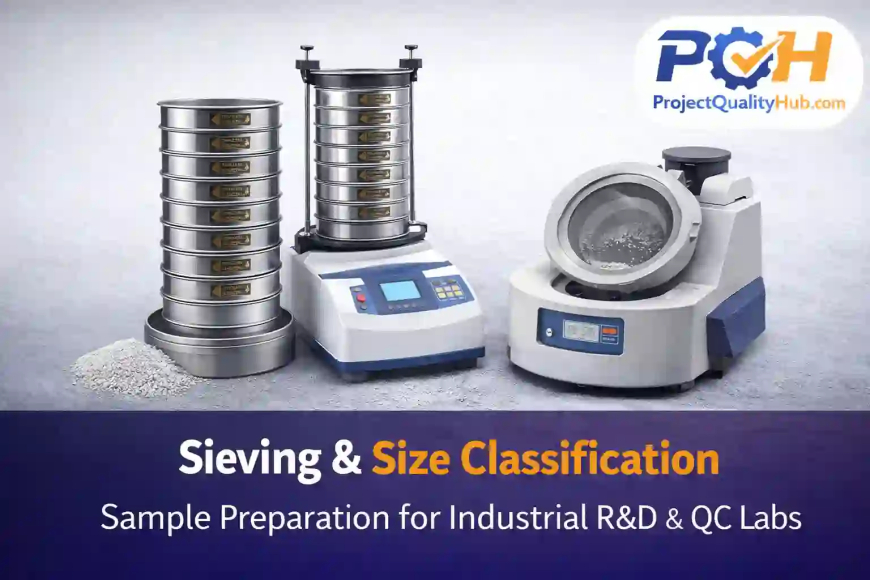
Introduction: Why Sieving Matters More Than Most People Realize
If you have ever worked inside a material testing lab, mining lab, cement laboratory, or steel plant QC lab, you probably noticed something interesting.
Even after crushing and grinding, the sample preparation process still isn’t finished.
There is one more critical step — Sieving & Size Classification.
Let’s understand this with a simple situation.
Imagine you ground a coal or limestone sample for testing. The powder might still contain different particle sizes — some very fine, some slightly coarse.
If these particles are not properly classified, your lab analysis results can vary.
That’s where sieving equipment comes in.
In simple words:
Sieving ensures that the sample has uniform particle size before laboratory testing.
And trust me — even a small particle size variation can affect results in chemical analysis, cement testing, mineral analysis, and soil testing.
What is Sieving & Size Classification?
Sieving and size classification is the process of separating particles based on their size using mesh screens.
This process is widely used in:
-
Mining laboratories
-
Cement quality control labs
-
Metallurgical testing labs
-
Soil testing laboratories
-
Pharmaceutical labs
-
Material science research labs
The objective is simple:
To ensure the sample particles fall within a specific size range required for accurate testing.
For example:
A laboratory might require powder below 75 microns for chemical analysis.
Sieving ensures that only particles meeting this size requirement are used.
Why Sieving is Important in Industrial R&D and QC Labs
Sieving might look like a simple process, but it directly affects test accuracy and reliability.
1. Ensures Uniform Particle Size
Different particle sizes can lead to inconsistent chemical reactions during analysis.
2. Improves Testing Accuracy
Uniform particles improve results in tests like:
-
XRF analysis
-
Cement fineness testing
-
Soil classification
-
Coal testing
3. Removes Oversized Particles
Sieving helps remove particles that were not fully ground during pulverizing.
4. Supports Standard Testing Procedures
Many testing standards like ASTM, ISO, and BIS require specific particle size limits.
Types of Sieving Equipment Used in Industrial Laboratories
Different laboratories use different types of sieving equipment depending on the material and accuracy required.
1. Laboratory Test Sieves
These are the most basic and widely used sieves.
They consist of metal mesh screens mounted in circular frames.
Features
-
Standard mesh sizes
-
Stainless steel construction
-
Used for manual sieving
Example
Used for cement fineness testing and soil particle classification.
2. Sieve Shakers
Manual sieving can be time-consuming. That’s why most modern laboratories use sieve shakers.
These machines automatically vibrate or shake stacked sieves, separating particles quickly.
Advantages
-
Faster sieving
-
More consistent results
-
Reduced manual effort
Example
Mining labs often use sieve shakers for mineral particle size analysis.
3. Air Jet Sieves
Air jet sieves use controlled air flow to separate very fine particles.
Best For
-
Very fine powders
-
Cement testing
-
Pharmaceutical samples
Advantage
Provides high precision particle classification.
4. Vibratory Sieve Systems
These systems use high-frequency vibration to classify particles.
Best For
-
Large sample volumes
-
Industrial laboratory testing
Advantage
Improves efficiency and repeatability.
Real-Life Example: Sieving Process in a Cement Quality Control Lab
Let’s take a real example from a cement plant QC laboratory.
Engineers need to test the fineness of cement powder, which affects:
-
Strength development
-
Setting time
-
Cement quality
Typical process:
Step 1 → Cement sample collected from plant
Step 2 → Sample dried and weighed
Step 3 → Passed through 90 micron sieve
Step 4 → Residue measured and recorded
If too much residue remains on the sieve, it indicates improper grinding in the cement mill.
So yes — a simple sieve test can influence plant operation decisions.
Step-by-Step Guide: Laboratory Sieving Procedure
Here is the typical sieving process used in most industrial labs.
Step 1: Sample Preparation
Ensure the sample is dry and properly ground.
Step 2: Select Correct Sieve Size
Choose the mesh size required by testing standards.
Step 3: Stack Sieves
Multiple sieves may be stacked in descending order.
Step 4: Place Sample on Top Sieve
Measured sample is placed on the top sieve.
Step 5: Start Sieve Shaker
Machine vibrates the sieves for a set time.
Step 6: Record Results
Material retained on each sieve is measured.
Advantages of Sieving & Size Classification
1. Accurate Particle Size Analysis
Ensures samples meet testing standards.
2. Simple and Reliable Method
Sieving is one of the oldest and most trusted particle analysis methods.
3. Cost Effective
Compared to advanced particle analyzers, sieving equipment is affordable.
4. Standardized Testing
Widely accepted in ASTM, ISO, and BIS testing methods.
Disadvantages of Sieving Equipment
1. Limited for Extremely Fine Particles
Very fine powders may require laser particle analyzers.
2. Time Consuming for Large Samples
Manual sieving can be slow.
3. Mesh Wear
Sieve mesh can wear out over time.
4. Requires Cleaning
Improper cleaning may affect future tests.
Common Mistakes in Laboratory Sieving
Even experienced technicians sometimes make these mistakes.
1. Using Damaged Sieves
Worn mesh can give inaccurate results.
2. Overloading the Sieve
Too much sample reduces sieving efficiency.
3. Insufficient Sieving Time
Particles may not fully separate.
4. Not Cleaning Sieves Properly
Residual particles may contaminate new samples.
Expert Tips from Industrial Labs
Here are some practical tips from real laboratory practices.
✔ Use Certified Standard Sieves
Always use sieves that comply with ASTM or ISO standards.
✔ Maintain Consistent Sieving Time
Consistency improves repeatability.
✔ Check Sieve Mesh Regularly
Damaged mesh affects particle classification.
✔ Use Sieve Shakers for Accuracy
Automated shaking improves precision.
✔ Keep Sieves Clean and Dry
Moisture can clog sieve openings.
Conclusion: Sieving & Size Classification Ensures Reliable Laboratory Results
In industrial laboratories, accurate testing depends heavily on proper sample preparation.
While crushing and grinding get most of the attention, sieving & size classification quietly ensures that samples meet the required particle size standards.
From cement plants and mining labs to steel plants and research laboratories, sieving plays a crucial role in producing consistent and reliable analytical results.
So the next time you see a sieve shaker vibrating in a lab, remember:
That small machine is helping engineers make big industrial decisions.
Frequently Asked Questions (FAQs)
1. What is sieving in laboratory sample preparation?
Sieving is the process of separating particles based on size using mesh screens.
2. Why is sieving important in QC laboratories?
It ensures uniform particle size, which improves testing accuracy.
3. What equipment is used for laboratory sieving?
Common equipment includes test sieves, sieve shakers, air jet sieves, and vibratory sieve systems.
4. What industries use sieving equipment?
Industries include mining, cement, metallurgy, pharmaceuticals, and soil testing laboratories.
5. What standards are used for sieve testing?
Common standards include ASTM, ISO, and BIS testing procedures.