Corrosion Testing Equipment Guide for Labs
Complete guide on corrosion testing equipment for labs with practical examples, types, and tips for engineers and students.
 Suraj Manikpuri
🧠 Why Corrosion Testing Matters (Real Talk)
A few years back, during a plant project, we faced an unexpected issue—newly installed pipelines started showing rust patches within weeks. Everyone was shocked. Material was standard, coating was done properly… then what went wrong?
Answer: No proper corrosion testing before installation.
Corrosion is silent. It doesn’t announce itself—it just damages equipment, reduces life, and increases maintenance cost. That’s why corrosion testing equipment in labs is not just for research—it’s critical for industries like steel, oil & gas, automotive, and construction.
Simple words mein:
👉 “Agar testing strong nahi hai, toh material ka future doubtful hai.”
Let’s understand everything practically.
🔍 What is Corrosion Testing?
Corrosion testing is the process of evaluating how materials (especially metals) react to environmental conditions like:
- Moisture (humidity)
- Salt (marine environment)
- Chemicals (acidic or alkaline)
- Temperature variations
It helps predict:
✔ Material life
✔ Coating performance
✔ Failure risk
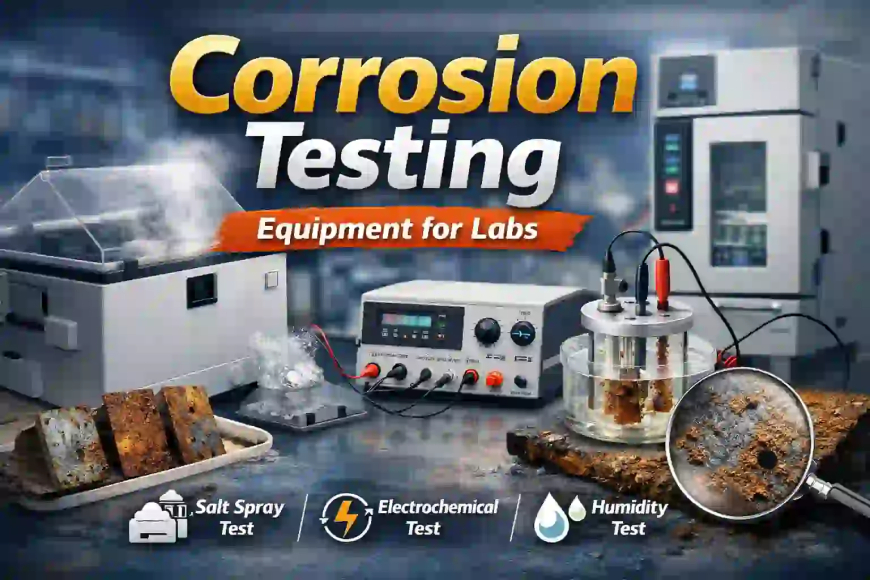
🧪 Types of Corrosion Testing Equipment Used in Labs
1. 🌊 Salt Spray Test Chamber (Most Common)
- Simulates marine or coastal conditions
- Uses salt fog (NaCl solution) to accelerate corrosion
- Widely used in coating industries
Where used?
Automotive parts, painted surfaces, galvanized steel
👉 Hinglish tip: “Yeh test basically samundar ka environment lab mein create karta hai.”
2. 💧 Humidity Chamber
- Controls temperature + humidity
- Tests corrosion under moisture conditions
Example:
Testing electrical panels or steel structures exposed to rain and humidity.
3. ⚡ Electrochemical Corrosion Testing Equipment
- Uses electrical methods (like potentiostat)
- Measures corrosion rate scientifically
Why important?
Gives fast and accurate results (R&D labs prefer this)
4. 🔥 Cyclic Corrosion Test (CCT) Chamber
- Combines salt spray + drying + humidity cycles
- More realistic than simple salt spray
Used in:
Automotive and aerospace industries
5. 🧴 Immersion Testing Setup
- Samples dipped in chemical solutions
- Used for chemical plants and pipelines
6. 🔍 Metallurgical Microscope (Support Equipment)
- Not a testing machine, but essential for analysis
- Helps observe corrosion pits and surface damage
🏭 Real-Life Example (From Industry)
In a steel plant project, we tested coated plates using a salt spray chamber for 500 hours.
Result:
- Coating A: Failed after 120 hours
- Coating B: Survived full test
👉 Final decision: Coating B used in project → saved maintenance cost for years.
Lesson:
“Lab testing = Long-term savings”
🛠️ Step-by-Step: How Salt Spray Test Works
- Prepare sample (clean & coat if required)
- Place inside chamber
- Spray salt solution continuously
- Maintain temperature (~35°C)
- Run test for specific hours (24, 48, 500+ hrs)
- Inspect corrosion (rust formation, coating failure)
👉 Simple language: “Artificially corrosion ko fast-forward kar dete hain.”
✅ Advantages of Corrosion Testing Equipment
✔ Predicts material life
✔ Helps select best coating
✔ Reduces maintenance cost
✔ Improves product quality
✔ Industry compliance (ISO, ASTM)
❌ Disadvantages / Limitations
✖ Lab conditions ≠ 100% real environment
✖ High initial cost of equipment
✖ Requires skilled operator
✖ Time-consuming for long-duration tests
⚠️ Common Mistakes Engineers Make
❌ Only relying on supplier data
❌ Ignoring environmental conditions
❌ Not calibrating equipment
❌ Wrong test duration selection
👉 Real tip: “500 hours test ka matlab 500 hours hi hota hai—shortcut nahi.”
💡 Expert Tips (From Practical Experience)
✔ Always match test type with actual environment
✔ Combine multiple tests (Salt + CCT + Electrochemical)
✔ Maintain proper sample preparation
✔ Record data properly (very important for audits)
✔ Follow standards like ASTM B117
🤔 Myths About Corrosion Testing
❌ “Salt spray test is enough for everything”
✔ Reality: It’s just one method, not complete solution
❌ “Higher test hours = better material”
✔ Reality: Depends on application
🔚 Conclusion: Don’t Ignore Corrosion Testing
If you’re working in any industry involving metals, coatings, or structures, corrosion testing equipment is not optional—it’s essential.
Small testing cost today can save lakhs tomorrow.
Simple takeaway:
👉 “Test before you trust the material.”
❓ FAQs (Frequently Asked Questions)
1. What is the most commonly used corrosion testing equipment?
Salt spray test chamber is the most widely used.
2. How long does corrosion testing take?
It depends—can range from 24 hours to 1000+ hours.
3. Is salt spray test reliable?
Yes, but it should be combined with other tests for accuracy.
4. Which industries use corrosion testing?
Steel, automotive, oil & gas, marine, construction.
5. What standard is used for corrosion testing?
ASTM B117 is the most common standard.
6. Can corrosion be completely prevented?
No, but it can be controlled and minimized.
Related Articles
- Sample Management Formats for Labs (Complete Guide)
- Quality Management Terminology Made Simple (A Practical Guide for Engineers & Students)
- Complete List of IS Standards for Sample Preparation Equipment in Industrial Research & QC Labs
- Download Sample Receipt Register as per IS Standard (Free + Audit Ready)