15 Essential Facts About Quality Management System (QMS)
Learn what a Quality Management System (QMS) is, how it works, its benefits, implementation steps, real examples, ISO 9001 connection, and expert tips.
 Suraj Manikpuri
15 Essential Facts About Quality Management System (QMS): Complete Practical Guide with Real Industry Examples (2026)
A Quality Management System (QMS) is a structured framework of policies, processes, procedures, and responsibilities used by an organization to consistently deliver products and services that meet customer and regulatory requirements while continuously improving performance.
Introduction
Imagine a manufacturing company receiving frequent customer complaints about defective products.
Or a construction project facing repeated rework because procedures are not properly followed.
Or a laboratory failing audits due to poor documentation.
What is the common root cause behind these problems?
In many cases, the answer is the absence of an effective Quality Management System (QMS).
A QMS helps organizations standardize processes, reduce errors, improve customer satisfaction, and achieve consistent results.
Whether you are a student, engineer, quality professional, project manager, or business owner, understanding QMS is one of the most valuable skills in today's competitive environment.
In this guide, you will learn:
✔ What a QMS is
✔ Why organizations implement it
✔ Key components of a successful QMS
✔ Real industrial examples
✔ Common mistakes
✔ ISO 9001 relationship
✔ Practical implementation tips
What is a Quality Management System (QMS)?
A Quality Management System (QMS) is a formalized system that documents and controls how an organization manages quality.
It consists of:
-
Policies
-
Procedures
-
Work Instructions
-
Records
-
Responsibilities
-
Audits
-
Improvement Activities
The objective is simple:
Deliver consistent quality while continuously improving organizational performance.
Simple Definition
A QMS is a systematic way of ensuring that work is done correctly, consistently, and efficiently every time.
Why is a Quality Management System Important?
Many organizations focus only on fixing problems.
A QMS focuses on preventing problems before they occur.
Benefits of QMS
| Without QMS | With QMS |
|---|---|
| Frequent errors | Reduced errors |
| High rework costs | Lower rework |
| Customer complaints | Better customer satisfaction |
| Inconsistent processes | Standardized processes |
| Audit failures | Improved compliance |
| Employee confusion | Clear responsibilities |
Real Observation
In steel plant projects, I have seen equipment commissioning delays caused by missing inspection records and unclear procedures.
After implementing standardized quality procedures, documentation errors reduced significantly and project handover became smoother.
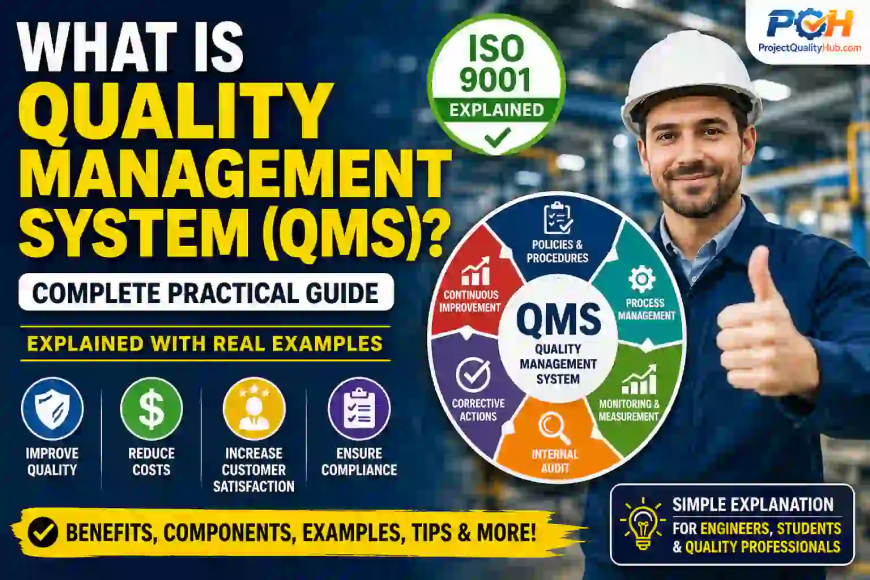
Main Components of a Quality Management System
A strong QMS is built on several key elements.
1. Quality Policy
Defines the organization's commitment toward quality.
2. Quality Objectives
Measurable targets such as:
-
Reduce defects by 20%
-
Improve customer satisfaction score
-
Reduce rework costs
3. Process Management
Clearly defined workflows.
4. Documentation Control
Ensures employees use the latest approved documents.
5. Internal Audits
Checks whether processes are followed correctly.
6. Corrective Actions
Addresses root causes of problems.
7. Continuous Improvement
Focuses on improving performance over time.
How Does a QMS Work? Step-by-Step Workflow
Step 1: Define Requirements
Identify customer and regulatory requirements.
Step 2: Develop Processes
Create standardized workflows.
Step 3: Train Employees
Ensure everyone understands procedures.
Step 4: Monitor Performance
Track KPIs and quality metrics.
Step 5: Conduct Audits
Identify gaps and non-conformities.
Step 6: Take Corrective Action
Solve root causes.
Step 7: Improve Continuously
Implement lessons learned.
QMS Workflow
Customer Requirement
↓
Process Planning
↓
Execution
↓
Inspection & Monitoring
↓
Audit
↓
Corrective Action
↓
Continuous Improvement
↓
Customer Satisfaction
Practical Examples of QMS
Manufacturing Industry
A bearing manufacturer uses QMS to:
-
Control raw materials
-
Monitor production quality
-
Perform inspections
-
Track customer complaints
Construction Industry
A contractor uses QMS to:
-
Control drawings
-
Manage inspections
-
Maintain quality records
-
Reduce rework
Healthcare Industry
Hospitals use QMS for:
-
Patient safety
-
Medical record control
-
Risk management
Laboratories
Testing laboratories use QMS for:
-
Calibration
-
Test procedures
-
Traceability
Real Industry Case Study
Problem
A fabrication workshop experienced:
-
High rejection rates
-
Welding defects
-
Delayed deliveries
Root Causes
-
No standard procedures
-
Inconsistent inspections
-
Poor documentation
Solution
Management implemented a QMS including:
-
Welding procedures
-
Inspection checklists
-
Quality audits
-
Employee training
Results
Within one year:
-
Rework reduced by 35%
-
Customer complaints reduced by 40%
-
Delivery performance improved significantly
Quality Management System vs Quality Control vs Quality Assurance
| Feature | QMS | QA | QC |
|---|---|---|---|
| Purpose | Manage overall quality | Prevent defects | Detect defects |
| Scope | Organization-wide | Process focused | Product focused |
| Timing | Entire lifecycle | Before issues occur | After production |
| Example | ISO 9001 System | Procedure reviews | Product inspection |
Advantages of Quality Management System
Major Benefits
✔ Improved customer satisfaction
✔ Reduced waste
✔ Better productivity
✔ Improved compliance
✔ Lower operational costs
✔ Better decision making
✔ Increased employee accountability
✔ Easier certification process
✔ Stronger brand reputation
Limitations of QMS
No system is perfect.
Challenges
-
Initial implementation cost
-
Documentation effort
-
Employee resistance
-
Training requirements
-
Management commitment needed
A QMS only works when people actually follow it.
Common QMS Mistakes
Mistake #1
Creating excessive documentation.
Mistake #2
Implementing QMS only for certification.
Mistake #3
Ignoring employee training.
Mistake #4
Not measuring performance.
Mistake #5
Treating audits as a formality.
Mistake #6
Failure to address root causes.
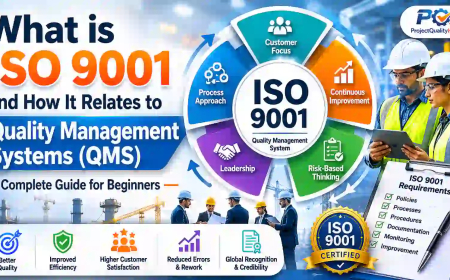
Quality Management System and ISO 9001
Many people confuse QMS and ISO 9001.
The Difference
A QMS is the management system itself.
ISO 9001 is an international standard that defines requirements for a QMS.
Think of it this way:
-
QMS = Vehicle
-
ISO 9001 = Driving Rules
A company may have a QMS without certification.
ISO 9001 certification demonstrates that the QMS meets internationally accepted requirements.
Expert Tips for Successful QMS Implementation
Pro Tip 1
Keep procedures simple.
Pro Tip 2
Focus on process improvement, not paperwork.
Pro Tip 3
Train employees regularly.
Pro Tip 4
Use digital quality management tools.
Pro Tip 5
Measure quality KPIs monthly.
Pro Tip 6
Encourage employee involvement.
Pro Tip 7
Use root cause analysis tools such as:
-
5 Why Analysis
-
Fishbone Diagram
-
Pareto Analysis
Conclusion
A Quality Management System (QMS) is far more than a collection of procedures and documents. It is a practical management framework that helps organizations consistently deliver quality products and services while continuously improving performance.
Organizations that successfully implement QMS often experience fewer defects, happier customers, lower costs, and stronger business growth. Whether you work in manufacturing, construction, healthcare, laboratories, or project management, understanding and applying QMS principles can significantly improve both operational performance and customer trust.
Frequently Asked Questions (FAQs)
What is the purpose of a Quality Management System?
To ensure consistent quality, customer satisfaction, compliance, and continuous improvement.
What are the main elements of QMS?
Quality policy, objectives, procedures, audits, corrective actions, and continuous improvement.
Is ISO 9001 mandatory?
No. ISO 9001 certification is voluntary in most industries.
Can small businesses implement QMS?
Yes. Even small organizations benefit significantly from QMS.
What is the difference between QA and QC?
QA prevents defects while QC identifies defects.
How long does QMS implementation take?
Typically 3–12 months depending on organization size.
What industries use QMS?
Manufacturing, construction, healthcare, laboratories, logistics, IT, and services.
Does QMS improve profitability?
Yes. Reduced waste, fewer defects, and improved efficiency often increase profitability.
What is a QMS audit?
A systematic review to verify compliance with defined procedures and requirements.
Can QMS be digital?
Yes. Modern organizations increasingly use cloud-based QMS software.