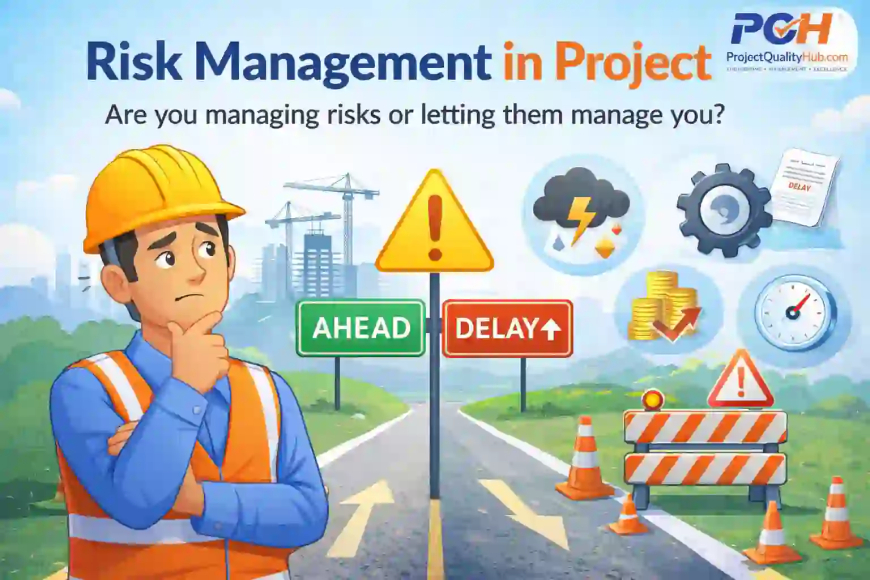
Risk Management in Project: Practical Guide
Learn practical risk management in project with real examples, steps, and expert tips. Simple guide for engineers and students.
 Suraj Manikpuri
📌 Introduction: A Small Mistake That Cost Big
A few years back, while working on a steel plant project, we faced an unexpected delay of almost 2 months. The reason? Something very basic — risk was never identified.
During excavation, underground utilities suddenly appeared. No backup plan, no contingency — bas kaam ruk gaya.
Result:
- Project delay
- Cost increase
- Client pressure
That day, one thing became very clear:
👉 Risk management is not theory — it’s real project survival.
Agar aap engineer ho ya student ho, this is something you must understand early.
🔍 What is Risk Management in Project?
In simple terms:
👉 Risk management means identifying possible problems in advance and planning how to handle them.
Projects never go exactly as planned — yeh reality hai.
Smart engineers don’t avoid risks…
👉 They manage them proactively.
⚙️ Why Risk Management is Important?
Ignoring risks is like driving without brakes — thoda dangerous nahi, bahut dangerous.
Without proper risk management:
- ❌ Project delays become common
- ❌ Budget goes out of control
- ❌ Quality suffers
- ❌ Client trust breaks
Real Insight:
“A well-planned project without risk management is still incomplete.”
🧠 Types of Risks in Projects
1. Technical Risks
- Design errors
- Equipment failure
2. Financial Risks
- Cost overrun
- Wrong estimation
3. Schedule Risks
- Material delays
- Labour shortage
4. External Risks
- Weather issues
- Government approvals
5. Safety Risks
- Site accidents
- Unsafe working conditions
👉 Har project mein inka combination hota hai — ignore mat karo.
🛠️ Step-by-Step Risk Management Process
Step 1: Risk Identification
Start with a simple question:
👉 “What can go wrong?”
Examples:
- Drawing delay
- Vendor failure
- Power shutdown
Simple lagta hai, but most people skip this step.
Step 2: Risk Analysis
Now check:
- Probability (kitni chances hain?)
- Impact (kitna damage hoga?)
| Risk | Probability | Impact |
|---|---|---|
| Material delay | High | High |
| Rain | Medium | Medium |
Step 3: Risk Prioritization
👉 All risks are not equal.
Focus on:
- High probability
- High impact
Yehi aapke critical risks hain.
Step 4: Risk Mitigation Planning
Now prepare solutions:
- Alternative vendors
- Extra buffer time
- Backup machines
👉 Plan B hona must hai.
Step 5: Monitoring & Control
Risk management is not one-time.
👉 Regularly review:
- Weekly meetings
- Site visits
- Progress tracking
“Set and forget” yahan kaam nahi karta.
🏗️ Practical Example (Real Site Case)
Situation:
Steel fabrication project mein material delay ho raha tha.
Risk:
Vendor not delivering on time
Action:
- Secondary vendor ready rakha
- Extra stock maintain kiya
Result:
Project delay avoid ho gaya ✅
👉 Lesson: Always keep backup options ready.
📋 Advantages of Risk Management
✔️ Smooth project execution
✔️ Better cost control
✔️ Strong decision-making
✔️ Team confidence boost
⚠️ Disadvantages (Reality Check)
❌ Time-consuming process
❌ Over-planning ho sakta hai
❌ Not all risks are predictable
👉 But honestly — benefits always outweigh the effort.
❌ Common Mistakes (Avoid These)
- Ignoring risks completely
- Only doing paperwork (no action)
- Not involving team members
- Ignoring past project learnings
- Not updating risk register
👉 “Excel mein likh dena enough nahi hai — implementation matters.”
💡 Expert Tips (From Real Experience)
👉 Always add 10–15% buffer time
👉 Listen to site engineers — unko ground reality pata hoti hai
👉 Choose vendors carefully
👉 Maintain a simple risk register
👉 Review risks weekly
Golden Line:
“If you don’t manage risks, risks will manage your project.”
🔚 Conclusion: Risk Management is a Must-Have Skill
In today’s fast-paced project environment, risk management in project is not optional — it’s essential.
Whether you are a student or an experienced engineer:
👉 Identifying risks = Smart planning
👉 Managing risks = Successful execution
Agar aap chahte ho ki next project smoothly complete ho:
👉 Start thinking about risks from Day 1.
❓ FAQs
1. What is risk management in project?
It is the process of identifying, analyzing, and controlling potential problems before they occur.
2. What is the difference between risk and issue?
Risk is a future possibility; issue is a current problem.
3. What is a risk register?
A document that lists all risks along with mitigation plans.
4. Is risk management required for small projects?
Yes, even small projects have risks — scale may differ, but importance remains.
5. What is the most important step in risk management?
Risk identification — because you can’t manage what you don’t see.