Crushing Equipment for Sample Preparation in Industrial Labs
Understand crushing equipment for primary size reduction used in industrial R&D and QC labs. Learn types, uses, advantages, and real lab examples.
 Suraj Manikpuri
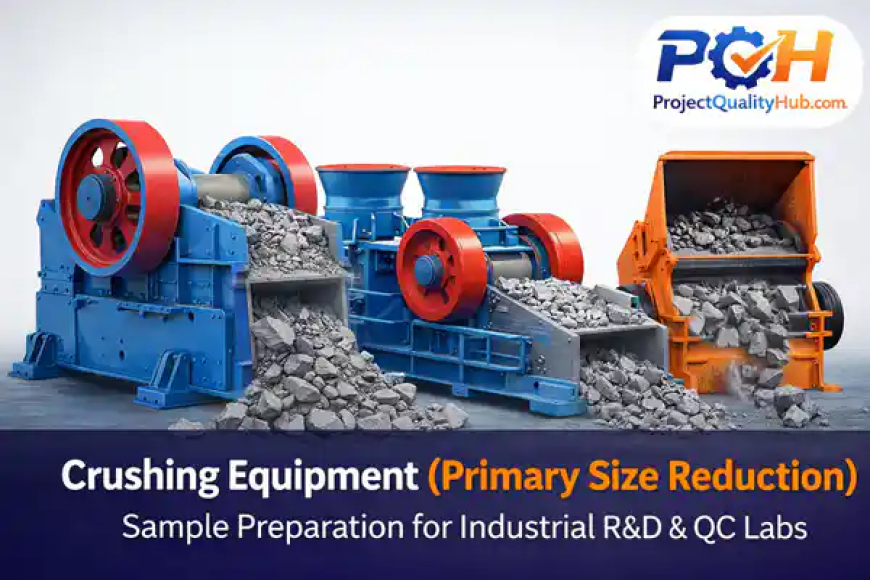
Introduction: Why Crushing Equipment Matters More Than You Think
If you have ever worked in a materials testing lab, mining lab, cement plant laboratory, or steel plant R&D center, you already know one simple truth:
A test result is only as good as the sample you prepare.
Imagine analyzing iron ore, coal, limestone, slag, cement clinker, or mineral samples without properly reducing their size. The sample becomes non-representative, and the test results become unreliable.
This is where Crushing Equipment (Primary Size Reduction) becomes essential.
In industrial R&D and Quality Control (QC) labs, crushing equipment is the first and most critical step of sample preparation. It reduces large solid samples into smaller, manageable sizes so they can be further processed, analyzed, or tested.
In simple words:
No proper crushing → No accurate testing.
Let’s understand how these machines work and why they are so important.
What is Crushing Equipment in Sample Preparation?
Crushing equipment refers to machines used to break down large solid materials into smaller pieces during the primary size reduction stage.
The purpose is not to make powder yet, but to reduce the sample size to a manageable level before fine grinding or pulverizing.
Typical materials processed include:
-
Iron ore
-
Coal
-
Limestone
-
Cement clinker
-
Slag
-
Minerals
-
Rocks
-
Metallurgical samples
For example:
A 50 mm rock sample might be reduced to 5–10 mm pieces before grinding.
Why Primary Size Reduction is Important in Industrial Labs
Primary size reduction plays a huge role in ensuring accurate and repeatable test results.
1. Improves Sample Representativeness
Large samples may have uneven composition. Crushing helps create a uniform sample.
2. Enables Further Processing
Many analytical machines require fine powders, which can only be produced after initial crushing.
3. Saves Time in Grinding
Pre-crushed material reduces the load on grinders and pulverizers.
4. Improves Testing Accuracy
Uniform particle size ensures consistent chemical and physical testing results.
In QC labs, even a small variation in particle size can distort analytical results.
Types of Crushing Equipment Used in Industrial R&D and QC Labs
Different materials require different crushing technologies.
1. Jaw Crushers
Jaw crushers are among the most commonly used primary crushers in laboratories.
How They Work
They operate using two plates (jaws):
-
One fixed jaw
-
One moving jaw
The material is crushed by compression between these jaws.
Best For
-
Hard rocks
-
Minerals
-
Ores
-
Slag
Example
Mining laboratories often use jaw crushers to prepare iron ore samples for chemical analysis.
2. Roll Crushers
Roll crushers use two rotating cylinders to crush materials.
The material passes between the rolls and gets crushed by compression and shear forces.
Best For
-
Coal
-
Limestone
-
Soft minerals
Advantage
Produces uniform particle size.
3. Hammer Crushers
Hammer crushers use rotating hammers that strike the material repeatedly until it breaks.
Best For
-
Brittle materials
-
Coal
-
Gypsum
-
Limestone
Limitation
Not suitable for very hard materials.
4. Cone Crushers (Sometimes used in labs)
Cone crushers operate using a rotating cone inside a fixed outer shell.
Material is crushed between these surfaces.
Best For
-
Secondary crushing
-
Hard materials
-
Uniform reduction
Real-Life Example: Crushing in a Steel Plant Laboratory
Let’s take a real industrial example.
In a steel plant raw material laboratory, iron ore samples arrive in large lumps of 50–100 mm size.
Before chemical analysis:
Step 1 → Jaw Crusher reduces size to ~10 mm
Step 2 → Sample Divider ensures representative sample
Step 3 → Pulverizer reduces to powder
Step 4 → Sample goes for XRF or chemical analysis
Without proper crushing, composition analysis may become inaccurate.
Step-by-Step Sample Preparation Using Crushing Equipment
Here is a typical workflow used in many industrial laboratories.
Step 1: Sample Collection
Large bulk samples are collected from the production line or mine.
Step 2: Primary Crushing
Jaw crusher or roll crusher reduces large lumps.
Step 3: Sample Mixing
Crushed sample is mixed thoroughly.
Step 4: Sample Division
Using riffle dividers or rotary sample dividers.
Step 5: Secondary Grinding
Pulverizers or mills produce fine powder.
Step 6: Laboratory Testing
Chemical or physical analysis is performed.
Advantages of Crushing Equipment
1. Fast Size Reduction
Crushers quickly reduce large material sizes.
2. Improves Testing Accuracy
Uniform particle size improves analytical results.
3. Handles Hard Materials
Jaw crushers can crush very hard rocks and ores.
4. Reduces Manual Work
Automation improves productivity.
5. Consistent Output
Provides repeatable sample preparation.
Disadvantages of Crushing Equipment
Despite many benefits, crushers also have limitations.
1. Equipment Wear
Hard materials can cause jaw or hammer wear.
2. Noise and Dust
Crushing generates dust and noise, requiring proper lab safety measures.
3. Maintenance Required
Regular inspection and lubrication are necessary.
4. Over-Crushing Risk
Improper settings may produce too fine particles.
Common Mistakes in Sample Crushing
Even experienced technicians sometimes make these mistakes.
1. Overloading the Crusher
Too much material can damage equipment.
2. Improper Cleaning
Cross contamination may occur between samples.
3. Wrong Crusher Selection
Using hammer crushers for very hard materials.
4. Ignoring Safety
Crushers require proper guards and PPE.
Expert Tips from Industrial Labs
Based on real lab practices, here are some practical pro tips.
✔ Always Pre-Inspect Samples
Remove metal pieces or foreign objects.
✔ Maintain Crusher Gap Settings
Proper gap ensures consistent particle size.
✔ Clean Between Samples
Especially important in chemical analysis labs.
✔ Use Dust Extraction Systems
Protects lab personnel and instruments.
✔ Schedule Preventive Maintenance
Worn jaws can affect crushing efficiency.
Conclusion: Crushing Equipment is the Foundation of Accurate Laboratory Testing
In industrial R&D and QC laboratories, crushing equipment may not look glamorous, but it is absolutely essential.
It forms the foundation of reliable sample preparation.
Without proper primary size reduction, laboratory results may become inaccurate, leading to wrong decisions in production, quality control, and research.
Whether it is mining, cement, steel, or material science labs, crushing equipment ensures that every test begins with a representative and properly prepared sample.
So next time you see a jaw crusher running in a lab, remember:
That machine is quietly ensuring the accuracy of the entire testing process.
Frequently Asked Questions (FAQs)
1. What is primary size reduction in laboratories?
Primary size reduction is the initial crushing of large samples into smaller pieces before further grinding or analysis.
2. Which crusher is commonly used in laboratories?
The jaw crusher is the most widely used crusher for laboratory sample preparation.
3. Why is crushing important in sample preparation?
Crushing ensures uniform particle size, making laboratory tests more accurate and reliable.
4. What materials are commonly crushed in QC labs?
Typical materials include coal, iron ore, limestone, minerals, slag, and cement clinker.
5. What safety precautions should be taken while using crushers?
Operators should use PPE, follow machine limits, avoid overloading, and maintain proper cleaning.
Related Articles
- Complete Sample Preparation Equipment List for Industrial R&D & QC Labs
- Grinding & Pulverizing Equipment for Industrial Labs
- Sieving & Size Classification Equipment for Laboratory Testing
- Magnetic & Density Separation Equipment for Laboratory Testing