Project Management Terminology Starting with “C” – Practical Guide for Engineers & Students
Learn project management terms starting with “C” in simple language with practical examples. Understand change control, constraints, critical path, contingency reserve and more.
 Suraj Manikpuri
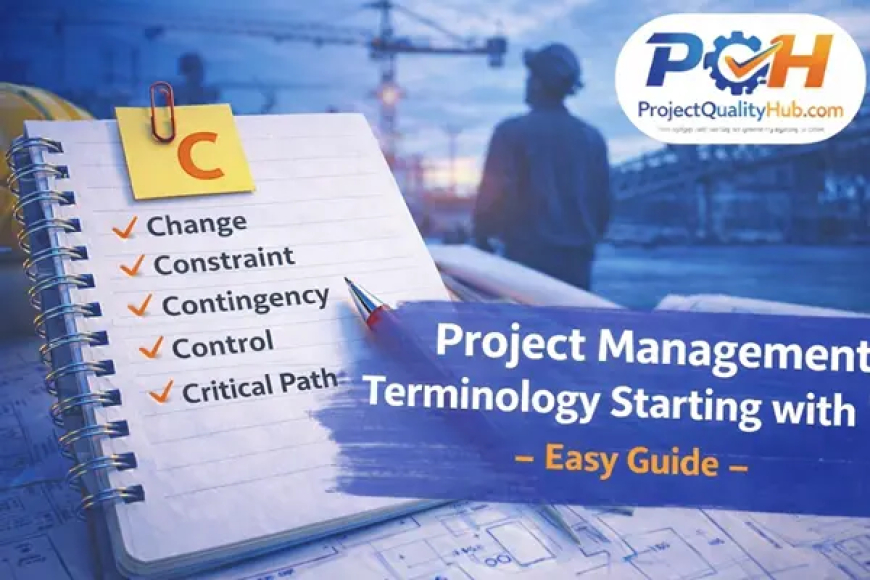
Project Management Terminology Starting with “C”
A simple and practical guide for engineers, students, and professionals
After learning “A” and “B” project management terms, now we move to the “C” terminology, which is extremely important in project execution, monitoring, and control.
From steel plant erection projects to IT and startup execution, these “C” terms are used daily in planning, coordination, risk handling, and performance tracking.
Let’s understand each term in clear, simple, real-life language.
1. Calendar Date
Definition: A specific date shown on a calendar (e.g., 10 March 2026).
Simple Meaning: Exact date, not a relative timeline.
Example:
“Pump installation will start on 15 April 2026” → This is a Calendar Date.
2. Capacity Assessment
Definition: Analysis of the ability of the project team, partners, and community to implement a project strategy.
Simple Meaning: Checking whether we have enough capability to complete the project.
Example:
Before starting a large erection project, you assess:
-
Skilled manpower
-
Equipment availability
-
Contractor capability
This is Capacity Assessment.
3. Change
Definition: Any difference from the planned value or expected event.
Simple Meaning: Any modification in scope, cost, time, or resources.
Example:
-
Design modification
-
Extra work added
-
Delay due to material shortage
All are Changes in project.
4. Change Control
Definition: A structured process to manage and approve changes in scope, cost, schedule, or quality.
Simple Meaning: A proper system to manage changes.
Steps in Change Control:
-
Identify change
-
Evaluate impact
-
Approve or reject
-
Implement and record
5. Change Request
Definition: A formal documented request to modify project scope, time, or cost.
Simple Meaning: Written request to make a change.
Example:
Client requests an additional pipeline line → You submit a Change Request.
6. Charter (Project Charter)
Definition: A formal document authorizing a project and giving authority to the project manager.
Simple Meaning: Official document that starts the project.
Includes:
-
Scope
-
Budget
-
Timeline
-
Project Manager authority
7. Closing
Definition: The formal process of completing and ending a project or project phase.
Simple Meaning: Properly finishing and handing over the project.
Activities in Closing:
-
Final inspection
-
Documentation
-
Client acceptance
-
Lessons learned
8. Communication
Definition: The process of sending, receiving, and interpreting information.
Simple Meaning: Sharing information clearly.
Types of Communication:
-
Verbal
-
Written
-
Formal
-
Informal
Example:
Daily site meeting, email updates, drawings discussion—all are part of Communication.
9. Concept Phase
Definition: The first phase of the project life cycle where need and feasibility are defined.
Simple Meaning: Idea and feasibility stage.
Activities:
-
Identify problem or opportunity
-
Check feasibility
-
Prepare business case
10. Conflict Management
Definition: The process of identifying and resolving disagreements.
Simple Meaning: Handling disputes in a healthy way.
Example:
Conflict between:
-
Mechanical team and electrical team
-
Contractor and client
Good conflict management avoids delays.
11. Consensus
Definition: Agreement among decision-makers where everyone can accept the decision.
Simple Meaning: Everyone agrees or can live with the decision.
Important Point:
If someone strongly disagrees, then consensus is not achieved.
12. Constraint
Definition: A limitation that restricts the project.
Simple Meaning: Something that limits your project.
Examples:
-
Fixed deadline
-
Limited budget
-
Shortage of manpower
Constraints are usually outside the control of the project team.
13. Contingencies
Definition: Planned actions to reduce the impact of potential problems.
Simple Meaning: Backup plans.
Example:
If rain delays civil work → shift work to indoor fabrication.
14. Contingency Reserve
Definition: Extra time or budget kept aside for known risks (known unknowns).
Simple Meaning: Extra safety margin.
Example:
-
Extra 10% cost kept for rework
-
Extra 5 days for delay
This is Contingency Reserve.
15. Control
Definition: Comparing actual performance with planned performance and taking corrective action.
Simple Meaning: Monitoring and correcting work.
Example:
-
Planned progress = 60%
-
Actual progress = 45%
→ Take corrective action
16. Critical Activity
Definition: An activity with zero float that cannot be delayed.
Simple Meaning: Task that must be completed on time.
Example:
If pump foundation is delayed → entire project delayed.
That activity is Critical Activity.
17. Critical Path
Definition: The longest sequence of activities that determines project duration.
Simple Meaning: The path that controls project completion time.
Important Points:
-
Delay in critical path = delay in project
-
There can be more than one critical path
-
It may change during project
Related Articles
- Project Management Terminology for Beginners
- What is Project Management?
- Project Management Terminology Starting with “A”
- Project Management Terminology Starting with “B”
- Project Management Terminology Starting with “D”
- Project Management Terminology Starting with “E”
- Project Management Terminology Starting with “F”
- Project Management Terminology Starting with “G” & "H"